
The Brief
Engagement Scope
- GTM Advisory
- Digital Marketing
- Sales as a Service & consulting
Rebuilding the Foundation - The Diagnosis
Mapping Every Drop-Off to a Stage in the Buyer's Journey - Technical SEO, Content & Channel Execution, Before any campaign or CRM workflow was touched, an end-to-end audit of client's digital presence, content, and sales process was done. Every finding was tagged to the stage of the buyer's journey, where it was actually costing a prospect and not just logged as a generic “issue.”
Observation: The company's digital presence across platforms was scattered and inconsistent. In several places, the company name was misspelled, and multiple duplicate accounts existed. This kind of fragmentation is common among cybersecurity startups in India scaling too fast for their branding to keep up.
Solution: The existing digital presence was thoroughly audited, validated, and consolidated. Duplicate accounts were removed, branding inconsistencies were corrected, and all digital platforms were aligned to create a unified brand presence.
Observation:
- The existing website was not SEO-optimized, resulting in low search visibility and an unstructured SEO foundation.
- Most of the website content was AI-generated, making it repetitive, less engaging, and not aligned with user intent or search engine best practices.
- The content was also highly technical, making it difficult for non-technical customers to understand.
- Additionally, the website had an inefficient structure with approximately 140 pages, many of which were unnecessary or poorly organized.
- Essential on-page SEO elements, including meta titles and meta descriptions, were either missing or not optimized, limiting the website's organic search performance.
Solution:
- A comprehensive SEO strategy was implemented by developing a targeted keyword framework and integrating relevant keywords across the website.
- The AI-generated content was rewritten and humanized, simplifying technical language into customer-friendly messaging that improved readability and engagement.
- The website structure was optimized by reducing the number of pages from 140 to 90, resulting in a cleaner and more effective information.
- Additionally, optimized meta titles, meta descriptions, and other on-page SEO elements were implemented across the website, creating a strong SEO foundation and improving the site's potential for organic search visibility.
Observation: There was no defined content strategy in place. Most of the published content was generic or highly technical, making it difficult for customers to understand. Additionally, the communication lacked a customer-centric approach, with no content tailored to address customer needs, pain points, or interests.
Solution: A comprehensive MarketingCommunicationPlan was developed to define what company would communicate across digital platforms and how those messages would be delivered to the target audience. Instead of focusing solely on products, the strategy was designed around the customerdecision-makingjourney, ensuring that communication aligned with how cybersecurity buyers perceive risk, evaluate solutions, and make purchase decisions. It's a working example of how digital marketing helps startups translate technical risk into a buying decision.
To achieve this, the communication strategy was structured into three distinct layers, with each layer serving a specific objective in nurturing prospects from awareness to trust and conversion.
The strategy was divided into three layers:
- Layer 1: Risk Awareness: Educating businesses about cyber threats, compliance gaps, and industry-specific risks to create awareness and urgency.
- Layer 2: Solutions & product highlight: Showcasing Client's solutions to demonstrate how business risks can be reduced.
- Layer 3: Trust & Proof: Building credibility through incident response, digital forensics, compliance readiness, and proven cybersecurity expertise.
The communication plan was executed in a phased manner, with campaigns aligned to each layer to systematically move prospects from awareness to trust and conversion.
Observation: The digital marketing efforts lacked a structured strategy and platform-specific direction. There was no clear audience segmentation, resulting in the same content being communicated to different customer without considering their intent or decision stage. Organic social media activities were not aligned with platform objectives.
Solution: A platform-wise strategy was developed by identifying the Ideal Customer Profile (ICP)and segmenting the audience into Customers (decision-makers) and Consumers (IT professionals and the tech community). Each audience was targeted on the most relevant platforms, with Instagram and YouTube focused on consumer education and engagement, while LinkedIn and Facebook were used to reach decision-makers through thought leadership, product communication, and trust-building content. The content was further structured into Brand Awareness, ProductAwareness, and Engagement pillars which was focused on purpose-driven communication across all digital platforms.
Engineering the Sales Engine
Turning a Raw Lead List Into a 14-Stage, Self-Tracking Pipeline
Content on digital platforms and on collaterals alone does not convert prospects into customers, especially in cybersecurity, where buying decisions involve multiple checks and longer sales cycles. To support the marketing strategy, a structured CRM pipeline and automated email nurturing journey was developed. A 14-stage sales pipeline was implemented to systematically track lead progression, identify drop-off points, and improve conversion across the sales funnel.
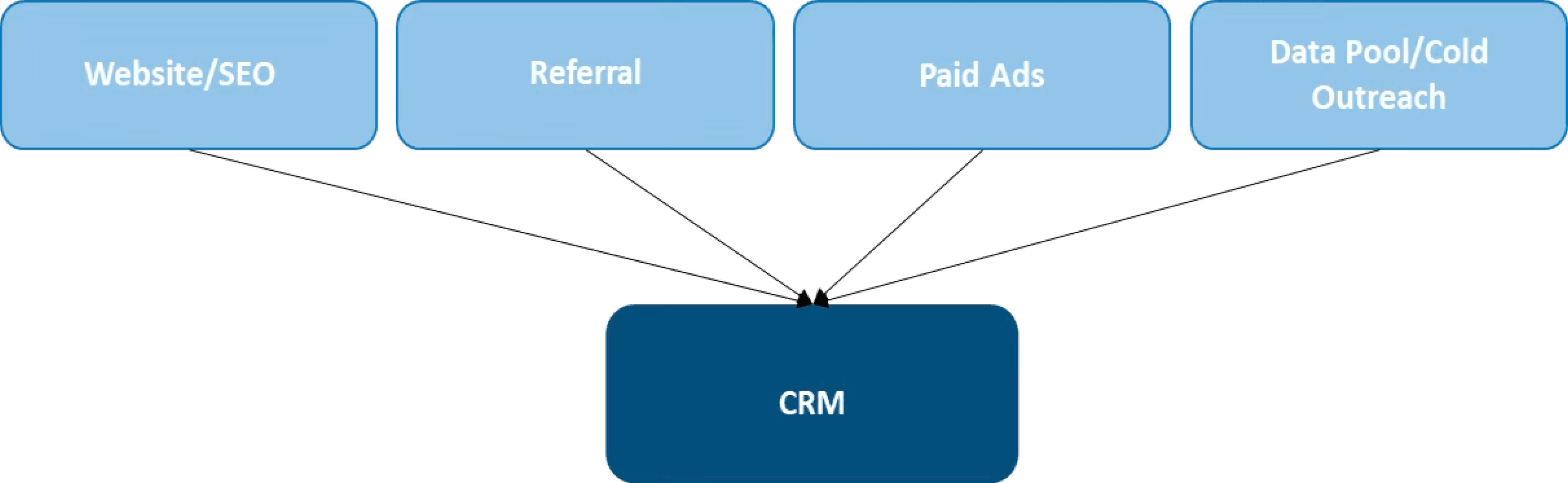
One CRM for every lead
All leads, whether generated through the website, referrals, marketing campaigns, or outbound outreach, were brought into a single place - CRM. Every lead was tagged by its source, assigned to the appropriate owner, and entered into a standardized follow-up workflow, improving visibility and response time.
A 14-Stage Pipeline, Six Operating Phases

Leads Mapping and Movement across stages with phases:
Every stage of the pipeline were assigned a defined actions and decision rules. High-priority leads were automatically escalated to senior sales representatives, large-value deals required manager approval, and missed demos triggered automated follow-ups. This ensured that every lead had a defined next step and no opportunity was left unattended.
Automated Email Nurture: The Education-Sector Journey
An automated email journey was developed specifically for the education sector to nurture prospects generated through cold outreach. The campaign was designed to educate decision-makers about cybersecurity risks, build awareness of company's solutions, and gradually move prospects from initial interest to sales-ready leads through a structured sequence of emails.
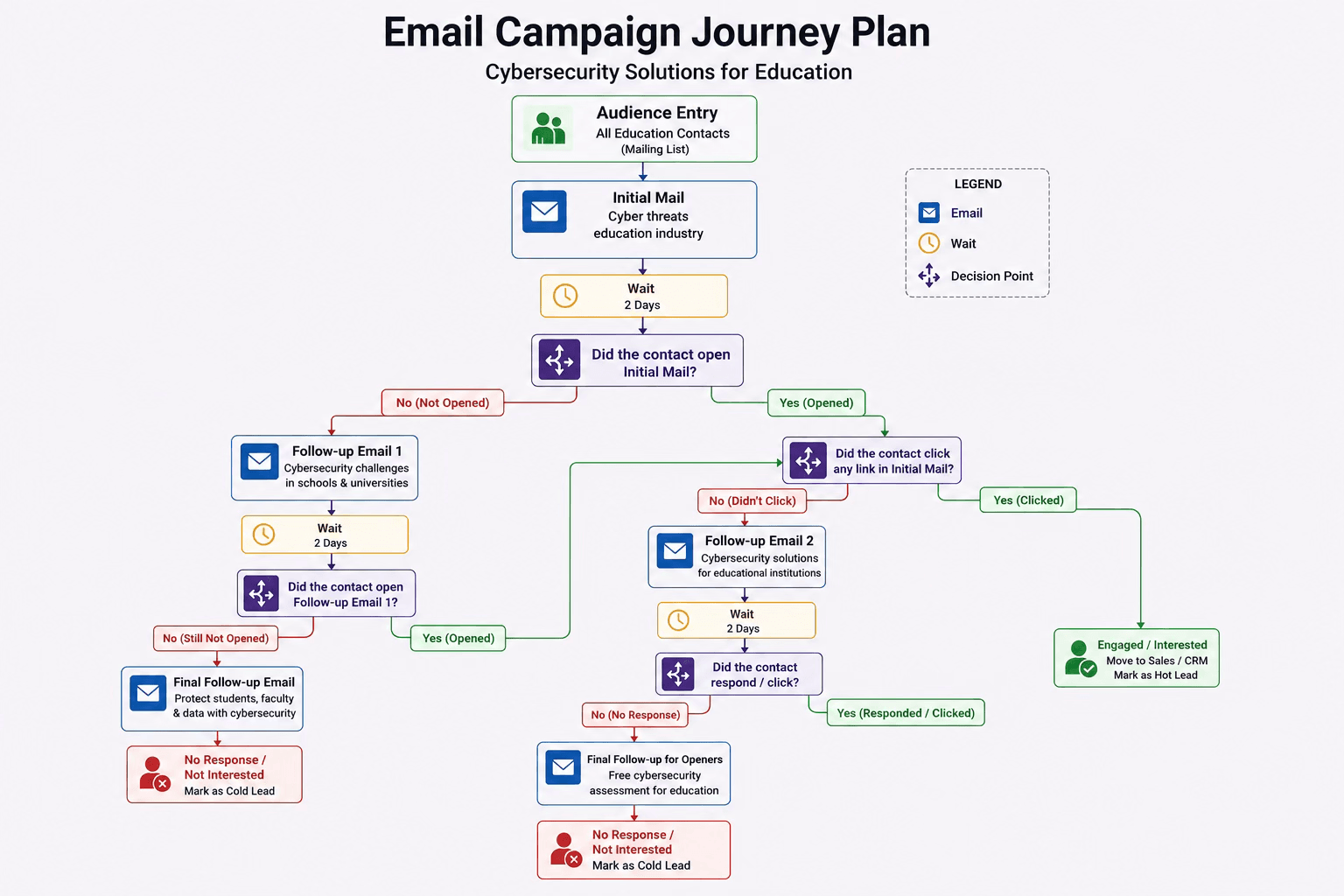
The logic is simple and self-correcting: every non-open or non-click triggers exactly one more relevant follow-up before a lead is marked Cold, while any open, click, or response immediately routes the contact to Sales and CRM as a Hot Lead - so sales time is spent only on prospects who have already shown intent.
Closing the Loop
Sales Signals Fed Straight Back Into What Gets Published and Automated Every objection or gap the sales team ran into was fed back into content, listings, or CRM workflow design - so marketing and sales-ops closed the same gaps working simultaneously on it and not in silos.
Sales Heard
“Our calling list is full of contacts who have nothing to do with cybersecurity.”
Marketing Built
Sector-specific content and keyword targeting (BFSI, healthcare, manufacturing, e-commerce, education), plus CRM lead-source tagging that routes cold-outreach data into structured qualification instead of a flat calling list.
Sales Heard
“Prospects don't feel any urgency to talk to us.”
Marketing Built
A dedicated Risk Awareness content development on attack statistics, regulatory penalty cases, sector vulnerabilities published ahead of any product pitch, and mirrored as the opening email in every nurture journey.
Sales Heard
“I re-explain what all each products do, on every single call.”
Marketing Built
A Solutions & Product content layer with a plain-language line for every product, a rebuilt company profile, and a CRM ‘Interested Product’ field that auto-triggers the right brochure and case study.
Sales Heard
“Leads go cold because nobody follows up on time.”
Marketing Built
A 14-stage CRM pipeline where every stage auto-creates its own next task and reminder, plus a parallel automated email journey that keeps unresponsive contacts moving instead of falling out of view.
This project showcases our expertise in cybersecurity marketing, B2B digital marketing, SEO for cybersecurity, GTM strategy, CRM implementation, marketing automation, and lead generation for technology businesses. By combining strategic consulting with execution, we helped build a strong digital foundation, improve search visibility, streamline lead management, and support long-term business growth. If you're looking for a digital marketing agency for cybersecurity companies, SEO services for B2B businesses, or a go-to-market strategy for a technology startup, we'd be happy to discuss how a similar approach can be applied to your business.