Lifecycle Marketing: How Businesses Can Leverage their Customer’s Journey into a Growth Engine
Introduction
Most companies know exactly how much they spend to acquire a customer. Far fewer can answer what happens after the acquisition.
- What happens when a lead enters the CRM but does not speak to sales?
- What happens after someone requests a demo, downloads a report, starts a free trial, or makes their first purchase?
- What signals tell the business that a customer is becoming more engaged, less engaged, ready for an upgrade, or at risk of leaving?
And perhaps the most important question:
Is the business actually responding to those signals?
This is where lifecycle marketing becomes strategically important. Most businesses still manage marketing as a collection of campaigns - acquisition campaigns, email campaigns, retargeting campaigns, product campaigns, retention campaigns etc.
Each of the above may perform well individually, but customers do not regard a business campaign as a campaign, instead they experience it as a ‘relationship’.
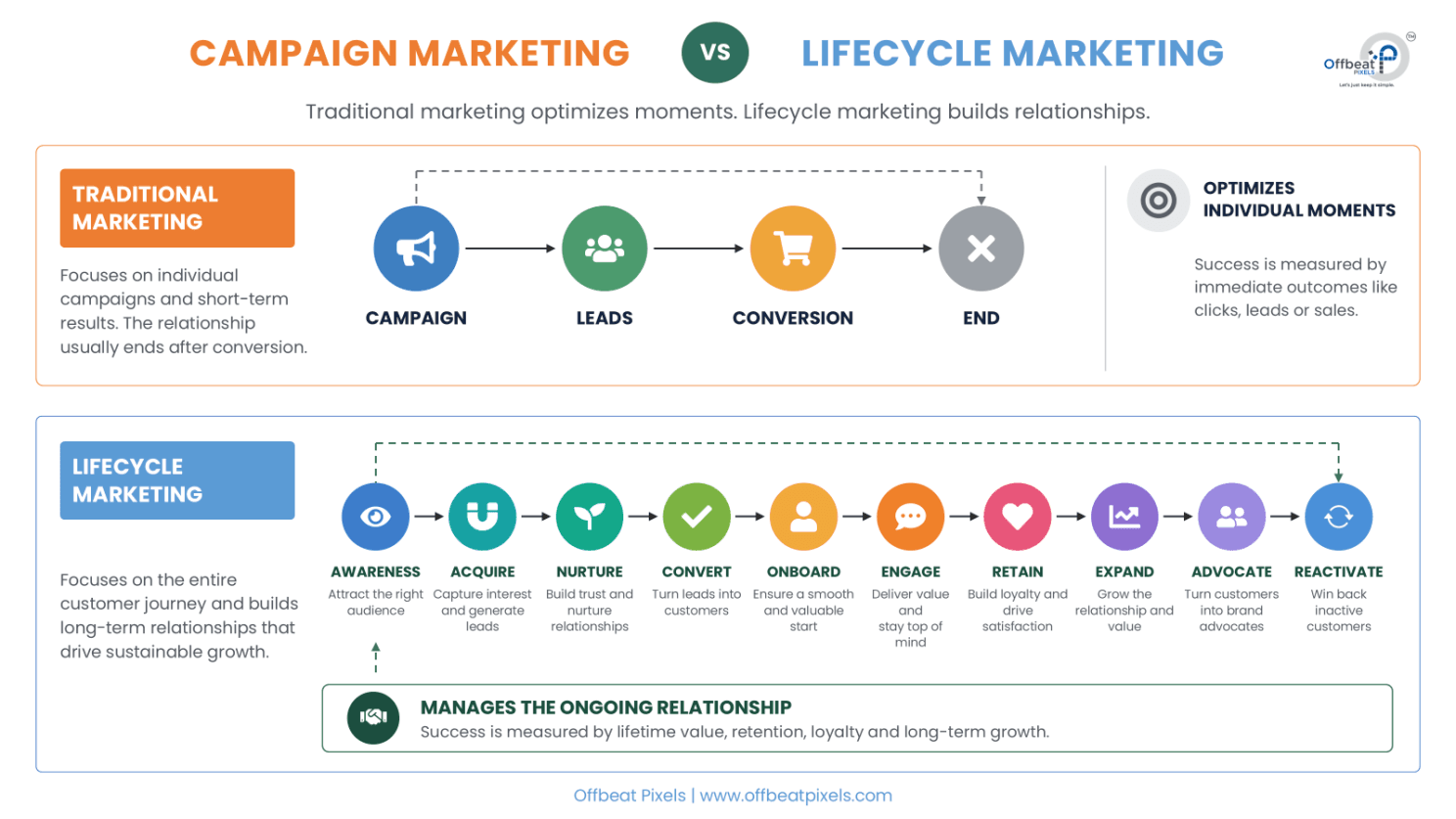
Traditional marketing asks: “How did this campaign perform?”
Lifecycle marketing asks: “What should happen next in the customer journey?”
That shift changes how businesses think about growth.
What Is Lifecycle Marketing?
Lifecycle marketing is the practice of engaging prospects and customers based on where they are in their relationship with a business and what they are likely to need next.
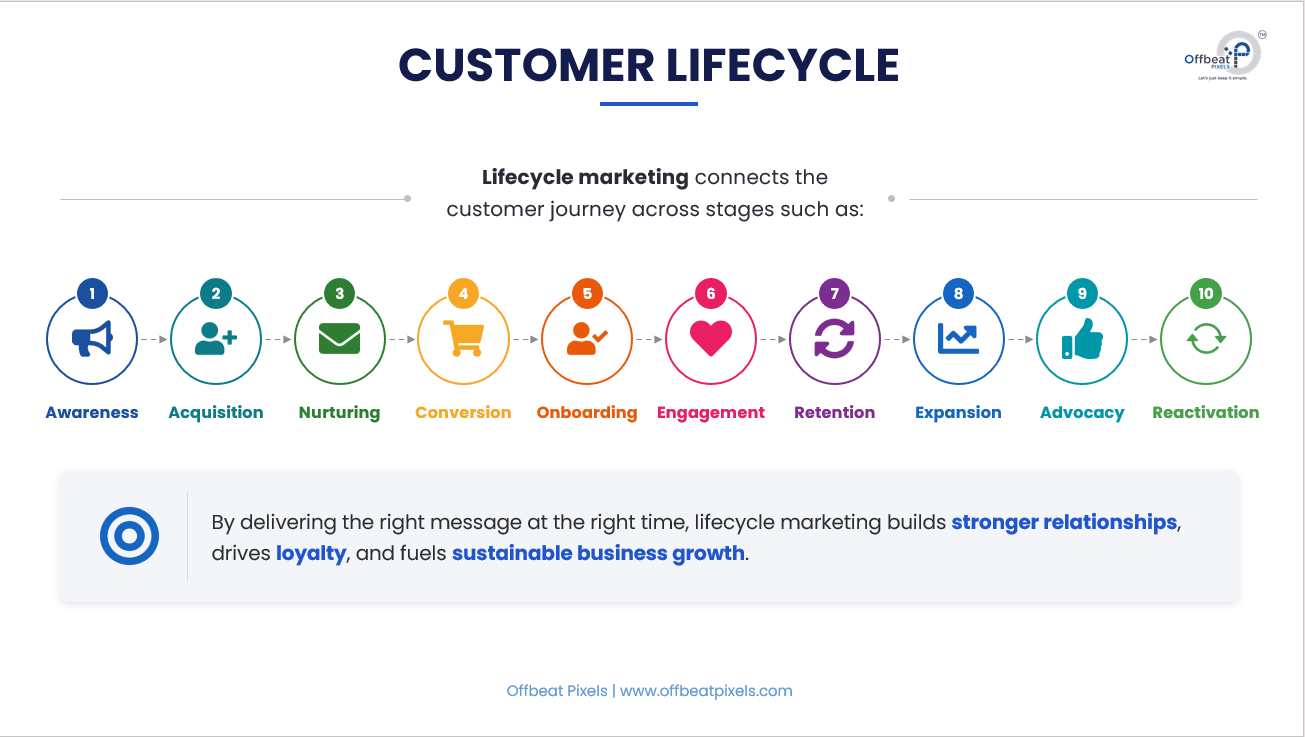
It connects the customer lifecycle/journey across stages such as:
- Awareness
- Acquisition
- Nurturing
- Conversion
- Onboarding
- Engagement
- Retention
- Expansion
- Advocacy
- Reactivation Customer Lifecycle
Customer Lifecycle
The exact stages will differ by business. A B2B SaaS company may focus heavily on activation, adoption, renewal and expansion. An e-commerce business may focus more on first purchase, repeat purchase, customer value and win-back.
The framework changes.
The principle does not: The next marketing action should be informed by the customer's current stage, behavior and needs.
This is why lifecycle marketing is more than email marketing. It can bring together CRM, marketing automation, sales, customer success, website experiences, paid media, product communication and customer data.
The objective is not simply to acquire more customers. It is to create a connected system that helps customers move toward the next valuable stage.
Difference between Campaign Based Marketing and Life Cycle Marketing – Why Campaign-Based Marketing Is Not Enough
Imagine a company generates 10,000 leads. The acquisition campaign is considered successful.
But what happens next?
Some leads receive sales outreach. Some enter a generic email list. Some receive nothing. Some are contacted repeatedly. Some become customers but continue receiving prospect communication. Others become inactive without triggering any intervention.
The campaign may have succeeded. The customer journey has not. This is the gap lifecycle marketing is designed to address. A mature lifecycle strategy asks four simple questions:
- What signal tells us a customer is ready to move to the next stage?
- What should happen when that signal appears?
- Who owns the action?
- What KPI tells us whether it worked?
That turns marketing from a collection of activities into a connected growth system.
Campaign Marketing vs Lifecycle Marketing
The Lifecycle Marketing Framework
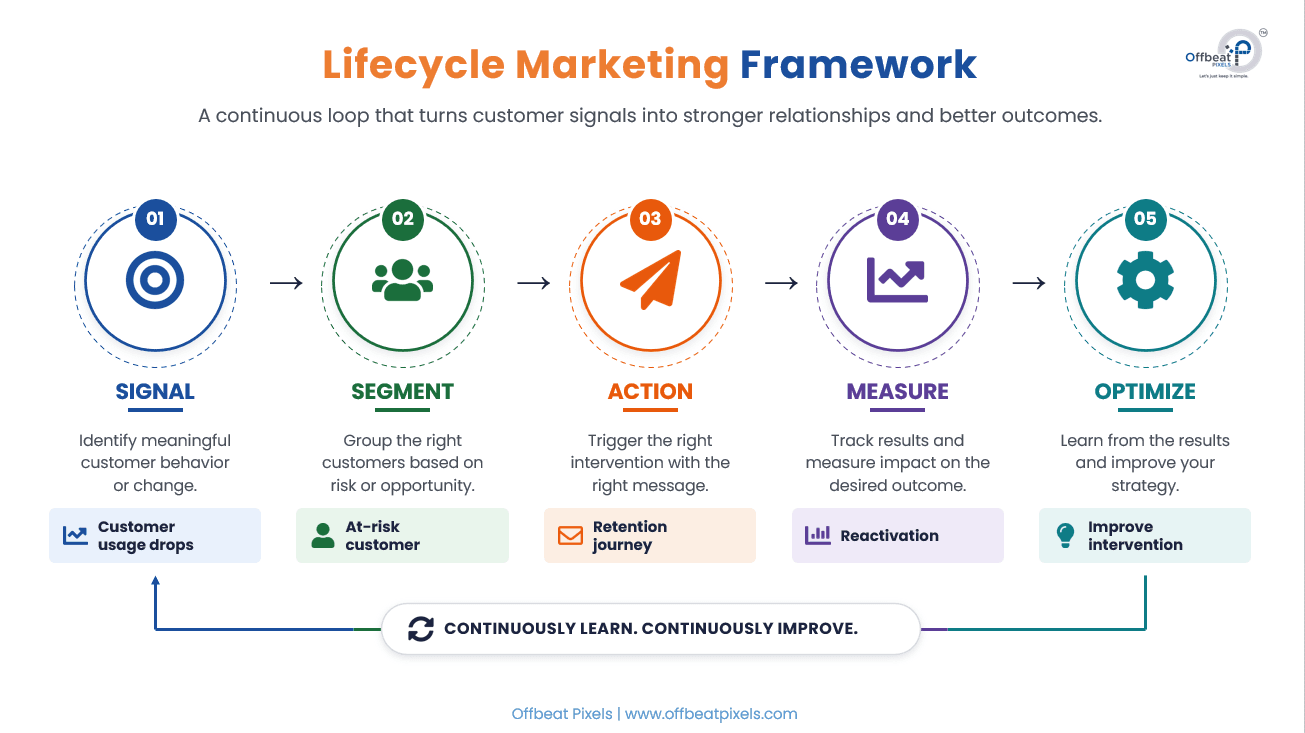
A simple way to build lifecycle marketing is:
- Signal: Identify meaningful customer behavior. This could be a demo request, repeated website visits, product usage, declining engagement, a purchase, an upcoming renewal, or increased account activity.
- Segment: Understand who the customer is and where they are in the lifecycle. Segments could be lifecycle stage, industry, company size, customer value, intent, engagement or purchase history. The goal is not to create multiple segments but to identify the relevant ones based on your business. A segment is useful when it impacts the decision.
- Action: Determine what should happen next. That could mean triggering an email, notifying sales, changing an audience, recommending content, alerting customer success, offering an upgrade or starting a win-back journey.
- Measure: Track business outcomes, not just communication metrics. Conversion, activation, retention, churn, expansion, customer lifetime value and reactivation are often more meaningful than opens and clicks alone.
- Optimize: Find where customers are getting stuck and improve that transition. This is where lifecycle marketing becomes a continuous growth discipline rather than a one-time campaign.
Lifecycle Marketing Framework
What Should CXOs Measure?
Lifecycle marketing should ultimately connect customer behavior to commercial outcomes.
The important question is not: “Did engagement increase?”
It is: “Did customer behavior improve in a way that affected revenue, retention or customer value?”
That is the difference between reporting marketing activity and measuring marketing performance.
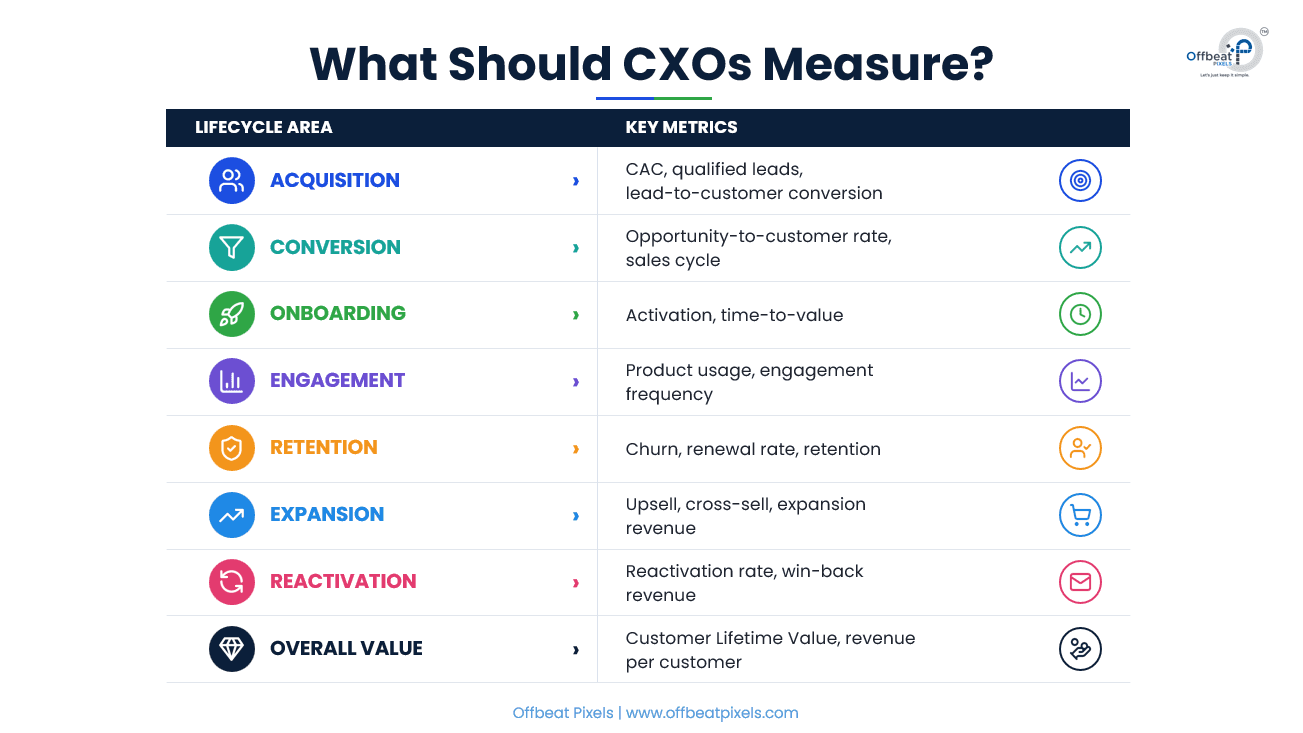
CXO Lifecycle Marketing Metrics Framework
Five Questions Every CXO Should Ask
If I were evaluating a company's lifecycle marketing maturity, I would start with five questions:
- Can we clearly define every important lifecycle stage? If different teams use different definitions of “lead,” “customer,” “active,” or “at-risk,” the system will struggle.
- Do we know what signals move customers between stages? If stage movement is based only on dates or manual updates, there may be significant blind spots.
- Does customer behavior trigger action ?Data sitting inside a CRM is not intelligence until it changes a decision.
- Can we measure where customers are getting stuck? Every lifecycle has leakage. The question is whether the organization can see it.
- Are we optimizing customer value, not just customer volume? Acquiring more customers is only one path to growth. Increasing the value of the customers already acquired is another.
Conclusion
The next phase of marketing maturity may not be about running more campaigns. It may be about building a better system around the customers those campaigns create.
The companies that understand lifecycle marketing well do not simply ask:
“How do we get more customers?”
They ask: “How do we create the conditions for each customer to take the right next step?”
That requires better data, clearer segmentation, stronger customer experiences, coordinated teams, and increasingly, smarter use of automation and AI. The real opportunity is not to communicate with customers more often. It is to understand:
- Where are they?
- What do they need?
- What should the business do next?
That is when marketing stops being a collection of campaigns and starts becoming a growth system.