Traditional Marketing Definition: Why Top Brands Still Use It? - 2026
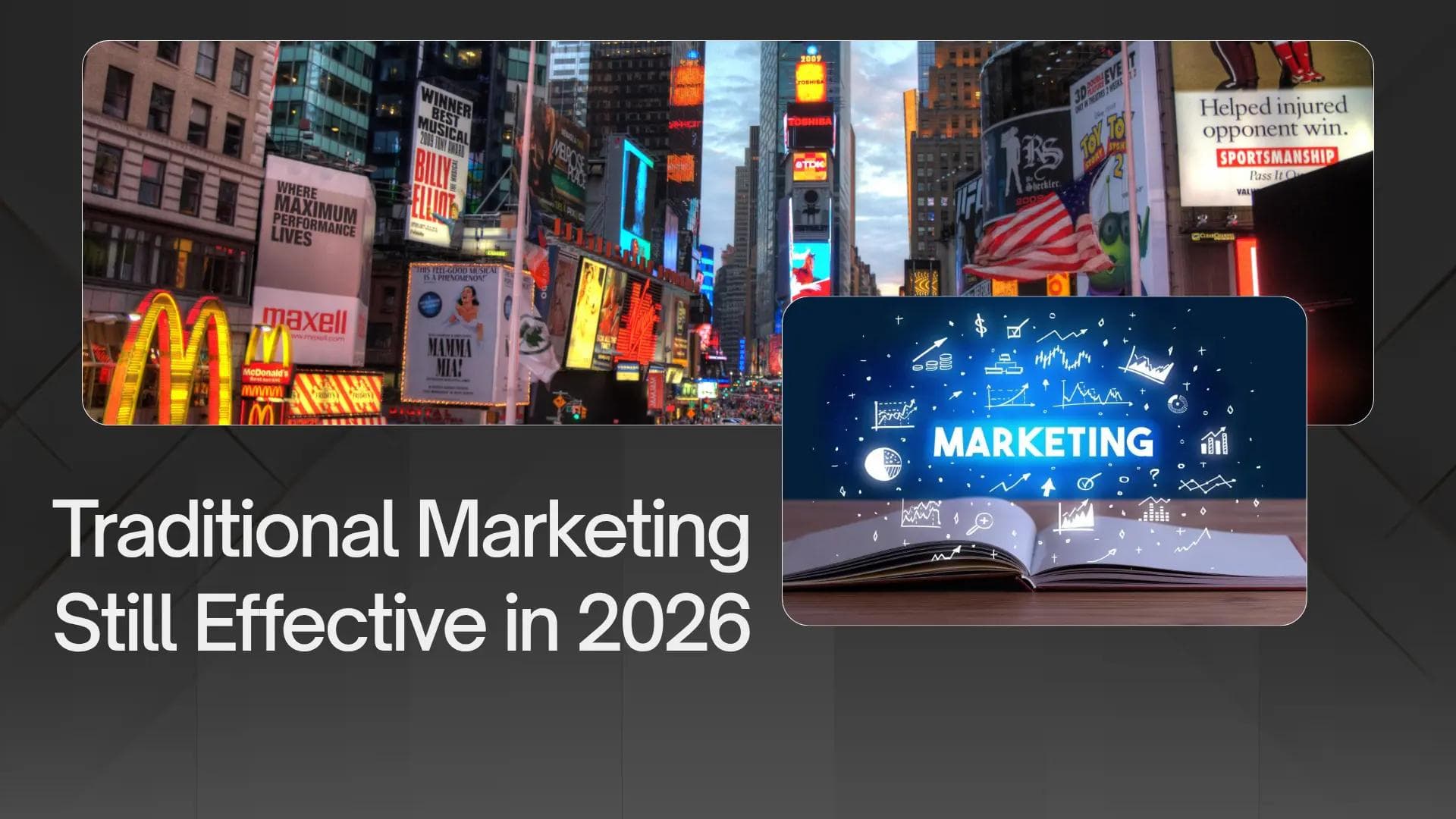
Traditional Marketing - What It Is and Why It Still Works
Global marketing spending on traditional hit $841 billion in 2024, and a large amount of it still goes to billboards, TV, and print. If you thought traditional marketing was fading out, the numbers say otherwise.
Introduction
Traditional marketing is one of the oldest ways businesses use to build brand awareness by using offline channels like print, TV, radio, direct mail, and outdoor ads to reach people without needing the internet. It falls under the "Promotion" element of the 7 Ps of marketing (Product, Price, Place, Promotion, People, Process, and Physical Evidence), and it's especially useful for reaching a type of audience that isn't spending much time online, like older or local customers. Unlike digital ads, it doesn't rely on algorithms or an internet connection, it simply shows up where people already are, again and again, until the brand becomes familiar.
This guide breaks down the traditional marketing definition, why it still matters, its strengths and weaknesses, and how each channel fits into a business's overall marketing strategy.
What is Traditional Marketing?
Traditional marketing means is to promoting a product or service through offline methods or things you don't need the internet to see or hear.
This includes:
- Print ads in newspapers and magazines
- TV and radio commercials
- Billboards and posters
- Direct mail like postcards or brochures
- Flyers and leaflets
- In-person events like trade shows and local sponsorships
A shop owner handing out flyers near a market, or a local radio station playing an ad for a nearby restaurant is doing traditional marketing. It doesn't rely on apps, websites, or internet connections to reach people.
Fact - Some traditional methods are still growing. Global experiential marketing and event sponsorship spending actually grew 8.3% in 2025 to $138.94 billion, even as some other formats like TV ads see a decline (PQ Media, 2026) [1].
Why is Traditional Marketing Important?
Traditional marketing is important because it reaches people wherever they are, without needing them to be online. Someone driving past a billboard, reading a newspaper, or walking past a shop sign sees your message without opening an app. This matters a lot for audience who don't spend much time online, and for local businesses that depend on people nearby.
It also builds trust. Many people still see print, TV, and radio ads as more credible than online ads, simply because these formats have been around for so long and feel more established, this is a key reason traditional marketing continues to shape brand awareness even in a digital-first market.
Traditional marketing is also best for community connection. Leaflet distribution remains an effective way to reach specific neighbourhoods without a large investment, letting even small companies connect directly with the customers closest to them. In-person formats matter too - trade shows and local networking events generate high-quality leads from people who are already genuinely interested, something that's much harder to guarantee with an online ad. This is exactly why is traditional marketing important within a broader marketing strategy: it builds the trust that other channels rely on later.
Fact -Traditional marketing is also simply everywhere. Printed materials show up at sports stadiums, doctors' offices, restaurants, and along roadsides, meaning most people encounter some form of traditional marketing every single day, often without realizing it.
What are the Advantages of Traditional Marketing?
Traditional marketing has stayed useful for many years, even with so many new ways to advertise. Because it uses physical items and broadcasts instead of screens people can quickly scroll past, it often builds more trust, reaches more people and leaves a longer-lasting mark. These traditional marketing benefits are exactly why it still earns a place in most companies' marketing strategy.
Here are the main advantages of traditional marketing:
- Grows audience reach across markets - TV, radio, and billboards help businesses reach consumers in wider markets, while flyers, direct mail, and local print connect with specific communities
- Builds brand trust and credibility - people often link traditional ads with bigger, well-known companies, which can make them more willing to buy
- Helps people remember your brand - hearing or seeing the same ad again and again on TV, radio, or print helps it stick in people's minds
- Offers constant visibility - things like billboards can be seen day and night, without anyone needing to click or open anything
Example: A local snack stall that hands out simple flyers near a college campus every semester often sees more walk-ins during exam weeks, simply because students recognize the flyer from past visits. No app, no ad account just repeated physical presence doing its job.
Fact: Printed materials show up at sports stadiums, doctors' offices, restaurants and roadsides which means most people run into some form of traditional marketing every single day, often without noticing it (Access to Media).
What are the Disadvantages of Traditional Marketing?
Even with its strengths, traditional marketing has some real downsides that businesses should think about before spending money on it. It usually costs more, is harder to change quickly, and it's tough to know exactly how well it's working.
Here are the main disadvantages of traditional marketing:
- High upfront costs - buying TV airtime, print space, or billboard placement often requires a large budget before any results are seen especially during high-demand periods like major events
- Difficult to measure ROI - it's hard to know exactly how many people saw a billboard or heard a radio ad and then made a purchase, making true return on investment unclear
- Limited audience targeting - you can choose a magazine or TV show based on its general audience, but this isn't as precise as targeting people by their specific interests or online behaviour
- Slow and costly to update - once a print ad or billboard goes live, it stays unchanged for weeks or months; fixing an error usually means waiting for a new print run or an entirely new design
- Short attention windows - outdoor ads like billboards are seen for only a few seconds by passing drivers, leaving little room for detail; a common rule of thumb is to keep a billboard message to seven words or fewer
Warning: Since traditional marketing is hard to measure and slow to change, don't put a large budget into one big channel like national TV without testing it on a smaller scale first. A weak billboard or a badly timed radio ad can run for weeks before you notice it isn't working, quietly wasting money the whole time.
What are the types of Traditional Marketing?
Businesses use different types of traditional marketing to promote products and services. It's been the foundation of advertising for well over a century, built on formats people can see, hear, or hold in their hands.
Some of these, like TV and radio, broadcast to a massive audience all at once. Others, like phone calls or direct mail, speak to one person at a time, more like a direct conversation than a public announcement.
Think of it like a toolbox - a hammer and a screwdriver are both "tools," but you wouldn't use them for the same job. A billboard builds brand awareness across an entire city, while a phone call builds a relationship with one specific prospect.
Fact - Global spending on traditional, offline media - print, TV, radio, and outdoor advertising - reached $841 billion on its own in 2024 - clear evidence that no single type of traditional marketing has been phased out, even as digital budgets have grown even faster (PQ Media, 2025) [2].
There are several types of traditional marketing, each built for a different purpose:
- Print Advertising
- Broadcast Advertising
- Direct Mail Marketing
- Outdoor Advertising
- Telemarketing
- Event Marketing
Print Advertising
Print advertising uses physical publications such as newspapers, magazines, brochures, flyers, catalogs, and pamphlets to promote products or services.
Businesses use print advertising to reach readers who already trust a particular publication, allowing the advertisement to benefit from that publication's credibility. Advertisers select publications based on readership demographics to ensure their message reaches the most relevant audience-for example, a golf equipment company advertising in a sports magazine or a skincare brand promoting its products in a lifestyle magazine.
Common examples include:
- Newspaper advertisements
- Magazine advertisements
- Brochures
- Flyers
- Catalogs
- Pamphlets
Fact - Printed materials still show up daily in stadiums, waiting rooms, restaurants, and along roadsides, meaning most people come across some form of print advertising every day without even noticing it (Access to Media).
Tip - Include a clear, simple call-to-action in every print ad for e.g a phone number, QR code, or discount code. Without one, readers have no easy way to act on the ad, even if it caught their eye.
Broadcast Advertising
Broadcast advertising promotes products or services through television and radio broadcasts, allowing businesses to reach large audiences simultaneously.
Businesses use it to build brand awareness quickly across a large population, since one airing can reach millions of households at once. To target audiences, brands pick specific channels, time slots, or programs that match their ideal customer
for example: airing during a morning news show to reach working professionals, or during a weekend sports broadcast to reach a younger, more active audience.
Common examples include:
- Television commercials
- Radio advertisements
Facts - Broadcast advertising became a major industry force during the 1950s advertising boom, when television first let brands step directly into people's living rooms, a shift that changed how products were sold forever [5].
Direct Mail Marketing
Direct mail is a marketing that sends physical materials through postcards, catalogues, or letters -straight to someone's home or office address.
Businesses use it to create a personal, tangible connection that's harder to ignore than a digital message; unlike an email that can be deleted in a second, a mailer has to be physically picked up and set aside on purpose. To target audiences, marketers use mailing lists built from location, past purchase history, or demographics, allowing a specific neighborhood or customer segment to receive a tailored offer.
Common examples include:
- Postcards
- Promotional letters
- Catalogs
- Coupons
- Product brochures
Fact - The average direct mail response rate sits at 4.4%, compared to just 0.12% for email - making it roughly 37 times more effective at getting a response (ANA/DMA 2025 Response Rate Report) [3].
Outdoor Advertising
Outdoor advertising also known as Out-of-Home (OOH) advertising, displays promotional messages in public spaces where people encounter them during their daily routines.
Businesses use it for constant, repeat exposure, since it's the one format nobody can mute, skip or close; it simply stays visible in the environment. To target audiences, brands choose locations strategically - a billboard near a business district reaches commuters, while a poster near a college reaches students - matching placement to where the ideal customer already spends time.
Common examples include:
- Billboards
- Transit advertisements
- Bus shelter advertisements
- Street furniture
- Posters
- Digital outdoor displays
Interesting detail - Outdoor advertising is one of the oldest marketing formats around, with the industry's official start tracing back to 1867, when the first billboard was leased (OAAA) [4].
Telemarketing
Telemarketing is the practice of reaching people directly by phone to promote a product, service or offer, usually with some existing relationship or opt-in involved.
Businesses use it to have real, one-to-one conversations that can clear up questions or objections instantly, something a static ad can never do. To target audiences, telemarketers rely on customer databases and past interactions, calling people who've already shown interest or made a previous purchase, which makes the outreach far more relevant than a random call.
Common examples include:
- Cold calling
- Warm calling
- Follow-up sales calls
- Customer retention calls
Tip -Keep a telemarketing script flexible, not word-for-word. Callers who sound like they're reading off a page tend to lose the listener within seconds,a natural, conversational tone consistently performs better.
Event Marketing
Event marketing promotes a brand through sponsorships, conferences, and branded experiences at a larger scale than a typical pop-up - think a company sponsoring a community sports tournament or hosting a booth at an industry expo.
Businesses use it to generate high-quality leads from people who are already interested enough to show up in person. To target audiences, brands choose events that align closely with their ideal customer's interests or industry, so the people in the room are already a strong match rather than a broad, unfiltered crowd.
Common examples include:
- Trade shows
- Exhibitions
- Product launches
- Sponsorships
- Pop-up stores
- Product demonstrations
- Community events
Fact - More than half of business leaders - 52% - believe events and trade shows deliver the highest ROI of any marketing channel they use (CEIR, 2025) [8].
What are Traditional Marketing Channels?
A traditional marketing channel is simply the medium or path a message travels to reach an audience -the actual route it takes to get from a business to a customer, without using the internet.
It's useful because choosing the right channel decides whether a message actually reaches the right person, at the right moment, in a way they're likely to notice.
Think of it like a delivery route. A courier can hand a package straight to someone's door, drop it at a pickup point, or leave it with a neighbor -different routes, same package. Marketing works the same way: the message might stay similar, but the channel decides how it physically gets to the audience, whether that's through a mailbox, a radio speaker, a billboard on the roadside, or a face-to-face conversation at an event.
This is slightly different from the types of traditional marketing covered earlier. Types describe the format a message takes -a TV ad, a flyer, a phone call. Channels describe the broader category that format travels through for e.g - broadcast, print, direct, outdoor, or in-person.
In other words, TV and radio are both types of advertising, but together they fall under the same channel: broadcast. Understanding channels helps group these formats logically, making it easier to see which route fits a specific goal.
The primary traditional marketing channels include:
- Print Channel
- Broadcast Channel
- Outdoor or Out-of-Home (OOH) Channel
- Direct Marketing Channel
- Event & In-Person Channel
- Word-of-Mouth Channel
Each one carries a message differently and each earns its place for a different reason. Let's walk through them one by one, and see what makes each channel worth a spot in a marketing plan.
1. Print Channels
Print channel delivers marketing messages through physical publications and printed materials distributed directly to consumers.
Includes:
- Newspapers
- Magazines
- Brochures
- Flyers
- Catalogs
- Pamphlets
Businesses use them for low-cost, tangible outreach that people can hold, read at their own pace, and keep for later. To target audiences, print channels are usually distributed at specific locations or handed directly to people who match a business's ideal customer profile.
Tip -Always give a print piece one clear next step -a phone number, a QR code, or a specific offer. A flyer with too many messages tends to get skimmed and forgotten.
2. Broadcast Channels
Broadcast channel deliver commercials through TV and radio signals, reaching large audiences the moment a spot airs.
Includes:
- Television
- Radio
Businesses use broadcast for fast, wide-scale brand awareness, since one airing can reach thousands or millions of people simultaneously. To target audiences, advertisers choose specific stations, channels, or time slots that line up with the viewing or listening habits of their ideal customer.
Fact - Radio alone reaches over 82% of drivers, and its listeners tend to be more open to ads than audiences on other channels (Connoisseur Media) [6].
3. Outdoor/Out-of-Home (OOH) Channels
Outdoor or Out-of-Home channel delivers advertisements through public spaces where consumers naturally encounter them during daily travel.
Includes:
- Billboards
- Transit advertising
- Bus shelters
- Street furniture
- Posters
- Digital outdoor screens
Businesses use OOH for constant, unavoidable visibility, since it's the one channel nobody can skip, mute, or close. To target audiences, businesses choose locations strategically, placing ads where their ideal customer already travels, works, or shops.
Fact - Outdoor advertising is one of the oldest marketing formats in existence, with the industry's official start tracing back to 1867, when the first billboard was leased (OAAA) [4].
4. Direct Marketing Channels
Direct marketing channel enables businesses to communicate directly with individual customers through personalized offline communication.
Includes:
- Direct mail
- Telemarketing
- Cold calling
- Promotional letters
- Printed catalogs
Businesses use these channels for personal, targeted outreach that can be tailored to a specific person or list, rather than a broad, general audience. To target audiences, marketers rely on customer databases, purchase history, or prospect lists filtered by location, industry, or past behavior.
Fact - The average direct mail response rate sits at 4.4%, compared to just 0.12% for email, making it roughly 37 times more effective at getting a response (ANA/DMA 2025 Response Rate Report) [3].
5. Event & In-Person Channels
Event and in-person channel allows businesses to engage customers through face-to-face interactions and live brand experiences.
Includes:
- Trade shows
- Exhibitions
- Conferences
- Sponsorships
- Product demonstrations
- Pop-up stores
- Community events
Businesses use these channels to create real, face-to-face conversations, which tend to leave a stronger impression than any screen-based ad. To target audiences, brands choose events and locations where their ideal customer is already likely to show up, ensuring the people in the room are a strong match rather than a random crowd.
Fact - Meeting a prospect face-to-face at an in-person event costs businesses roughly $142 per meeting on average - notably less than the $250+ it typically costs to meet a prospect at their own office (UPrinting) [9].
6. Word-of-Mouth
Word-of-mouth channel spreads marketing messages through personal recommendations and conversations between customers.
Unlike paid advertising, businesses cannot directly control this channel. Instead, they encourage it by delivering excellent products, services, and customer experiences that people naturally want to recommend.
Includes:
- Personal recommendations
- Customer referrals
- Offline conversations
- Community discussions
Businesses use it because it carries a level of trust that paid advertising simply can't buy. To target audiences, businesses focus on delivering a strong enough experience that satisfied customers naturally want to talk about it with friends, family, or colleagues.
Fact - 88% of consumers globally trust recommendations from people they know more than any other form of advertising, per Nielsen's most recent Global Trust in Advertising survey (Nielsen, 2021) [10].
Traditional Marketing vs Digital Marketing
Traditional marketing is any form of promotion that reaches people through offline media, without needing an internet connection. It includes channels like TV, radio, print, billboards, and direct mail, and it has been the main way businesses advertised for decades before the internet existed.
Digital marketing is any form of promotion that reaches people through online channels. It includes things like social media, search engines, websites, and email and it relies on the internet to deliver messages and track results.
How they work, in simple terms:
- Reach: Traditional marketing reaches a broad, general audience all at once, like everyone who drives past a billboard. Digital marketing can reach a more specific audience based on their interests or online behaviour.
- Internet dependency: Traditional marketing doesn't need the internet to work - a newspaper ad or radio spot reaches people regardless of whether they're online. Digital marketing only works for people who are connected or online.
- Message delivery: Traditional ads usually show the same message to everyone who sees them, like a billboard that looks identical to every passing driver. Digital ads can be adjusted or personalised for different viewers.
- Speed of results: Traditional marketing tends to focus on long-term brand building rather than quick action however Digital marketing can often produce faster, more immediate responses, like a click or a purchase.
- Tracking: Traditional marketing is harder to measure precisely, it's very difficult to know exactly how many people saw a billboard and acted on it. Digital marketing generally allows more direct tracking of views, clicks, and results.
- Cost structure: Traditional marketing often requires larger upfront costs, like buying TV airtime or print space. Digital marketing can usually start with smaller, more flexible budgets.
When weighing traditional marketing vs digital marketing, the real question isn't which one wins - it's which one fits the target audience and goal at hand.
Difference between Traditional Marketing vs Digital Marketing
| Factor | Traditional Marketing | Digital Marketing |
| Medium | Offline (TV, radio, print, mail, billboards) | Online (websites, social media, search, email) |
| Internet required | No | Yes |
| Audience reach | Broad, general audience | Specific, targeted audience |
| Message personalization | Same message for everyone | Can be adjusted per viewer |
| Speed of results | Slower, builds over time | Often faster, more immediate |
| Measurability | Harder to track precisely | Easier to track and measure |
| Cost structure | Higher upfront costs | More flexible, scalable budgets |
| Best suited for | Broad brand awareness, local reach, trust-building | Targeted campaigns, quick engagement, measurable ROI |
Conclusion
Traditional marketing continues to play a vital role because it reaches people wherever they are -without needing an internet connection. Whether through billboards on busy roads, print ads in newspapers and magazines, radio spots during daily commutes, direct mail in mailboxes, or in-person events, it delivers messages that feel real, credible, and memorable.
Its key strengths remain clear: broad audience reach across markets, strong brand awareness and credibility, repeated exposure that improves brand recall, and constant visibility that keeps your message in front of potential customers every single day. For local businesses especially, formats like flyers, leaflets, trade shows, and community sponsorships create direct community connections and high-quality leads from genuinely interested people.
If there's one idea to walk away with, it's this: traditional marketing earns trust before it earns a sale - everything else in a marketing plan builds on that foundation.
- Pick one channel that matches your immediate goal, not the one that feels the most familiar.
- Give people a way to act -a number, a code, a next step -so interest doesn't stall out.
- Follow up consistently -trust built offline still needs a next conversation to turn into a customer.
References
- PQ Media. "Global Experiential Marketing Grew 8% to $139 Billion in 2025 & Will Surge 10% in 2026." PRWeb, June 9, 2026.
- PQ Media. "Global Ad & Marketing Spend Surged 8.7% in 2024." Global Advertising & Marketing Spending Forecast 2025-2029, PRWeb, January 31, 2025. (Traditional/offline media spend: $841.09 billion in 2024.)
- Association of National Advertisers (ANA) / Data & Marketing Association (DMA), Response Rate Report, 2025 edition.
- Outdoor Advertising Association of America (OAAA). "History of OOH." oaaa.org.
- General industry history of broadcast advertising and the 1950s television advertising boom.
- Connoisseur Media. "Radio vs. Other Traditional Mediums." connoisseurmedia.com.
- Cognism. "The State of Cold Calling in 2026: Over 200K Calls Analysed." cognism.com, 2026.
- Center for Exhibition Industry Research (CEIR), 2025 data, as cited in Wave Connect, "Event Marketing Statistics 2026."
- UPrinting. "50 Interesting Trade Show Facts and Statistics Shaping 2025." uprinting.com/blog.
- Nielsen. Global Trust in Advertising report, 2021.