Digital Marketing Guide for Beginners: Basics & Fundamentals Explained
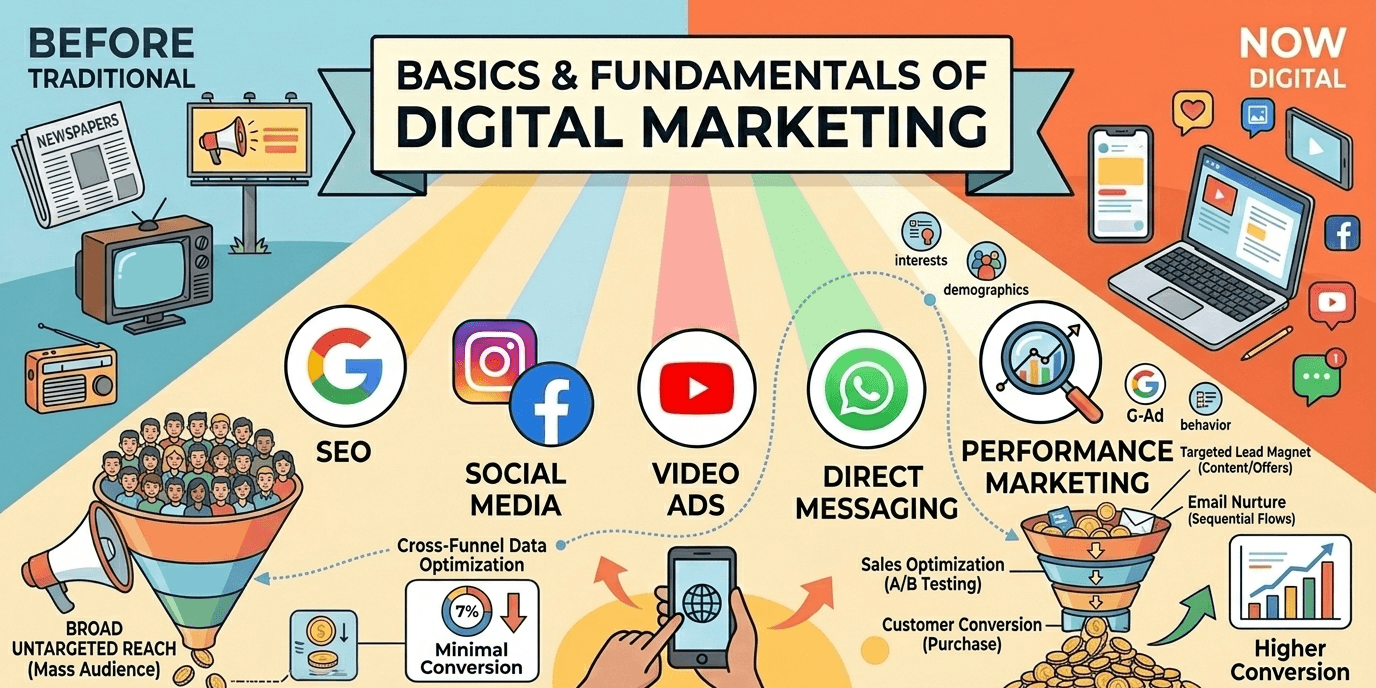
Basics and Fundamentals of Digital Marketing
Think about your own day. You wake up, check Instagram and a reel for a skincare brand stops you mid-scroll. On your way to work, you search "best chai near me" on Google, and three cafés show up with ads right on top. By evening, a WhatsApp message from your local store reminds you about a discount on groceries. None of this feels like an "ad campaign" it just feels like a normal day on your phone. But that's exactly what digital marketing is, quietly working in the background of almost everything you do online.
If you're a business owner, a student, or just someone curious about how brands grow online, this blog is your starting point. We'll keep things simple and walk through every basic concept you need to know about fundamentals of digital marketing - what it is, how it's different from traditional marketing, its main types, and all.
What is Digital Marketing
In the simplest words, digital marketing means promoting your product or service using the internet and digital devices like phones, laptops, tablets instead of newspapers, hoardings, or TV, wherever your audience is spending time online.
Think about how a food delivery app reminds you about a discount on your favourite biryani place, or how a fashion shopping app shows you ads for the same kurta you checked out yesterday. That's digital marketing using your browsing behaviour to show you same product.
A few common examples you've definitely come across:
- Google search ads that appear when you search for "best AC service near me"
- Instagram and Facebook ads showing up between your friends' posts
- YouTube ads before or during a video
- Promotional emails from brands you've shopped with before
- WhatsApp Business messages from local shops and service providers
Digital marketing covers all of this and a lot more, and it keeps evolving as new platforms and technologies come up.
Did you know?
India crossed 1.03 billion internet users as of end of 2025, with internet penetration at 70% - DataReportal, Digital 2026 India
Mobile devices remain the dominant means of internet access across both rural and urban India
This means your potential customer is almost certainly online and reachable through digital marketing.
Digital Marketing vs Traditional Marketing
Traditional marketing is the old - way of reaching people via newspaper ads, TV commercials, radio jingles, pamphlets, and hoardings on the highway. Digital marketing on the other hand, uses the internet to reach the same audience, but with a lot more precision.
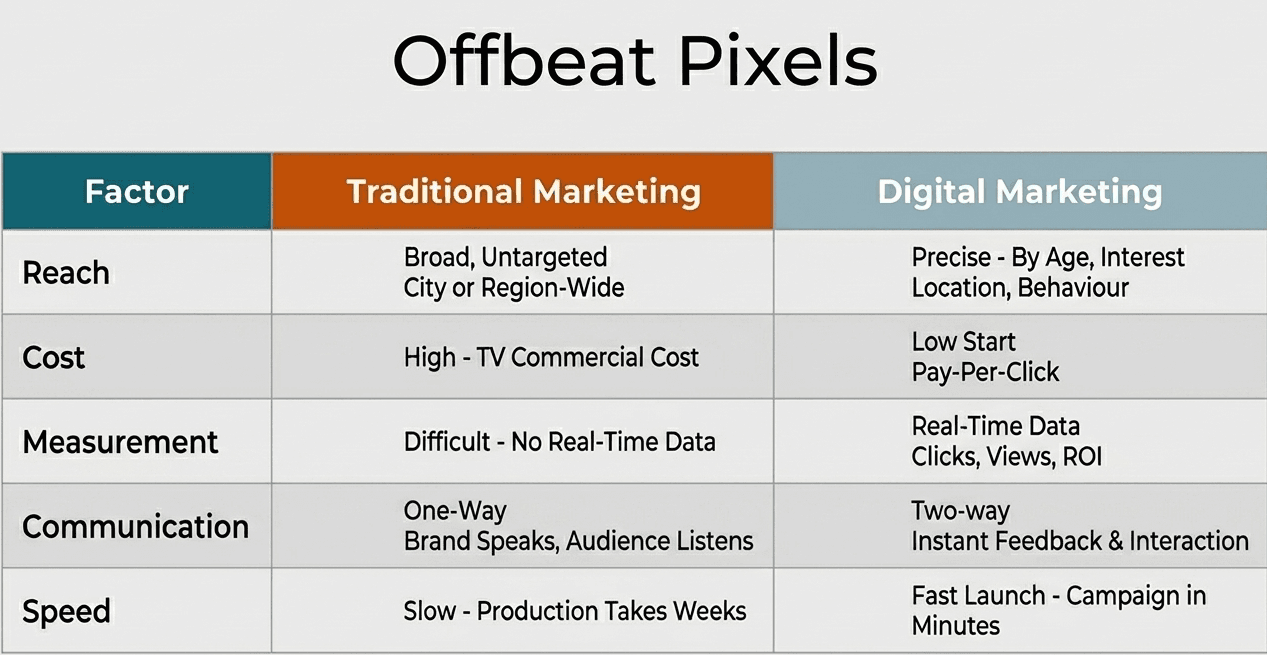
Here's the simple difference:
- Reach: Traditional marketing reaches everyone in a city or area, whether they're interested or not. Digital marketing lets you target only the people likely to actually want your product.
- Cost: A TV ad can cost lakhs of rupees where as in digital marketing, digital campaign can start with just a few hundred rupees a day.
- Measurement: With a newspaper ad, you can't really know how many people noticed it. With digital marketing, you can see exact numbers: clicks, views, and even purchases.
- Two-way conversation: Traditional ads are one-way but in Digital marketing lets customers comment, message, and react in real time.
That said, traditional marketing isn't dead, many big brands still use both together for maximum impact, especially during festive seasons or major sporting events.
Types of Digital Marketing
Digital marketing isn't just one single thing, it's actually a mix of different strategies that work together. Depending on your business goal, you might use one type more than the others, or combine a few of them.
Let's break down the types of digital marketing:
SEO (Search Engine Optimisation)
SEO is the process of improving your website so it ranks higher on search engines when people look for things related to your business.
For example, if someone searches "Digital marketing guide for beginners" on his device, good SEO can help your website appear on the first page instead of page five, where almost nobody scrolls to. SEO involves using the right keywords, writing helpful content, and making sure your website loads fast and works well on both website and mobile. It's a long-term game, but the results are usually worth the wait.
Did you know?
68% of all online experiences begin with a search engine - BrightEdge, 2019
Only 0.63% of searchers ever click on page 2 of Google results - Backlinko
If your business isn't on page 1, it is effectively invisible to most potential customers
If you want to go deeper into how SEO actually works, we've written a detailed guide on SEO basics you can check out.
Social Media Marketing
Social media marketing means using platforms like Instagram, Facebook, LinkedIn, and Pinterest to promote your brand and build a relationship with your audience.
For example, a small bakery can use Instagram reels to show behind-the-scenes baking, which over time turns casual followers into actual paying customers. It's not just about posting pretty pictures, it also includes running ads, replying to comments, collaborating with creators, and building a genuine community around your brand.
Did you know?
India had 500 million social media user identities as of October 2025 - DataReportal, Digital 2026 India Report
An average Indian spends 2 hours and 44 minutes daily on social media platforms
YouTube and Instagram are the two most used platforms in India for brand discovery
Performance Marketing
Performance marketing is the type of digital marketing where you only pay for actual results like clicks, leads, or sales instead of paying just for visibility.
For example, an online clothing store might run search and social ads where it pays only when someone actually clicks through and completes a purchase, rather than paying a flat fee no matter what happens. This approach is popular among businesses that want quick, measurable returns rather than waiting months for organic growth, which is why it's heavily used by brands selling products online, from clothing stores to ed-tech platforms.
Warning - Set your budget cap before you run a single ad.
Performance marketing can deliver fast results, but it can also drain your budget equally fast if left unchecked. Always set a daily or campaign spending limit in Google Ads or Meta Ads before a campaign goes live. Start small (₹200–₹500 a day), study the results for 7–10 days, then scale what's working. Never run ads without a clear maximum budget and a defined goal.
Influencer Marketing
Influencer marketing means partnering with people who already have an audience that trusts them like YouTubers, Instagram creators, or even local micro-influencers with just a few thousand followers.
For example, when a fitness influencer recommends a protein brand to their followers, that recommendation is often trusted more than a regular ad would be, simply because it comes from someone they already follow and relate to. This works especially well in India, where word-of-mouth and personal recommendations carry a lot of weight.
Online Reputation Management
Online Reputation Management or ORM is about managing what people say about your brand online - reviews on Google, comments on social media, and ratings on platforms like local business directories and food or service review apps.
For example, a single bad review left unanswered on a local listing can quietly turn away dozens of potential customers before they ever visit your store or website. This is why ORM matters: it involves responding to feedback professionally, encouraging happy customers to leave reviews, and fixing issues before they blow up online.
Tip - Reply to every review, positive and negative.
When a potential customer reads your Google reviews, they're not just reading what others say - they're watching how you respond. A professional, empathetic reply to a negative review shows future customers that you take feedback seriously. Set a reminder to check and respond to reviews at least once a week.
Content Creation and Marketing
Content marketing is about creating valuable, useful, or entertaining content like blogs, videos, infographics, podcasts to attract and engage your audience, without directly selling to them.
For example, this very blog you're reading right now is a piece of content marketing in action, giving you useful information instead of a sales pitch. The idea is simple: give value first, and trust will follow naturally. Good content also supports your SEO efforts, since search engines love fresh, helpful content.
Inbound vs Outbound Marketing
Digital marketing includes two primary methodologies: Inbound marketing and Outbound marketing. Learning to use both strategically can significantly enhance your results.
Outbound Marketing follows a “push” approach. It involves reaching out to potential customers with your message regardless of their immediate interest. Examples include cold calls, pop-up ads, banner advertisements, and broad email campaigns. While it can create quick visibility, it often feels interruptive and may lead to lower engagement in today’s ad-savvy environment.
Inbound Marketing adopts a “pull” strategy. You create high-value content and experiences that naturally attract people who are actively seeking solutions. When someone searches for answers, your helpful blog, video, or resource appears, drawing them to your brand organically.
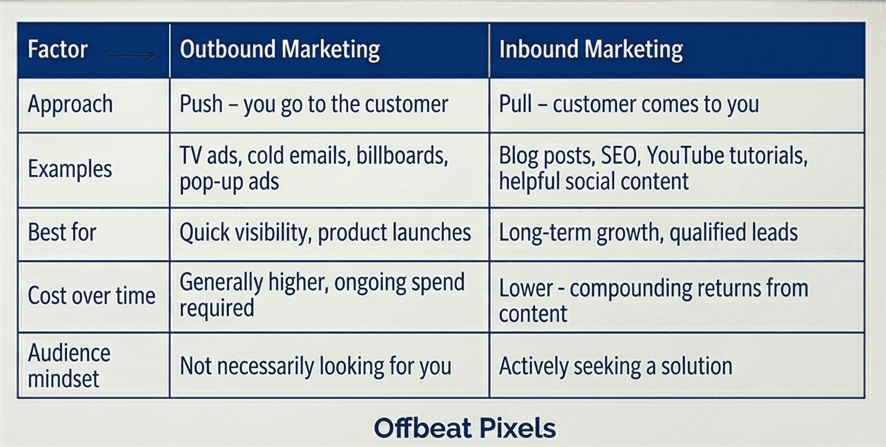
The most effective strategies often blend both approaches using outbound for immediate boosts and inbound for building a foundation.
Our digital marketing services at Offbeat Pixels emphasize inbound principles while incorporating smart outbound tactics where appropriate. This balanced method helps attract the right customers and nurture them effectively. We will cover advanced inbound funnel-building techniques in an upcoming detailed article.
Digital Marketing Funnel and Customer Journey
The digital marketing funnel illustrates the typical path a customer takes from initial awareness to becoming a loyal advocate. Mapping your efforts to this journey helps you deliver the right content at the right stage.
Awareness: Potential customers first learn about your brand through search results, social content, or advertisements. The objective is to create visibility and a positive initial impression.
Interest / Consideration: Interested prospects seek more information. They engage with blog posts, videos, webinars, or downloadable resources. This stage focuses on building trust and demonstrating value.
Decision: Ready-to-buy customers need reassurance. Compelling offers, testimonials, clear calls-to-action, and frictionless checkout processes help close the sale. Retargeting can be particularly effective here.
In India, this journey predominantly occurs on mobile devices, making a fast, intuitive website critical. The websites we develop at Offbeat Pixels are optimized to support seamless progression through every funnel stage. Using analytics tools like Google Analytics allows you to identify drop-off points and refine your approach. We will explore advanced optimization strategies in a future post.
Key Digital Marketing Channels Overview
Digital marketing channels refers to the platform or medium used to deliver your marketing message to the target audience. Choosing the right channels is crucial for reaching potential customers effectively, controlling costs, and maximizing results. The ideal mix depends on where your audience spends time, especially in India’s mobile-first, multilingual environment.
Here’s a clear overview of the most popular ones:
- Search Engines: Google and Bing, where people actively search for answers and products. SEO helps your website rank higher in organic results for sustainable traffic, while paid search (PPC) delivers instant visibility.
- Social Media: Instagram, Facebook, LinkedIn, YouTube and Threads. These platforms support organic posts, stories, reels, and targeted ads for brand awareness, engagement, and community building.
- Email: Still one of the highest ROI channels, used for newsletters, promotional offers, lead nurturing, and customer retention through personalized sequences.
- Affiliate Marketing: Partnering with other websites, bloggers, or creators who promote your products or services in exchange for a commission on sales or leads.
- Messaging Apps: WhatsApp Business and SMS marketing, which are huge in India for direct, personal communication, customer support, abandoned cart reminders, and quick promotions.
- Display and Video Ads: Banner ads and video ads shown across websites, apps, and YouTube for broader awareness and retargeting.
Did you know?
Email marketing delivers an average ROI of $36 for every $1 spent - Litmus, 2024 State of Email Trends Report
This is the highest ROI of any digital marketing channel - higher than paid search, social ads, or SEO
59% of consumers say marketing emails influence their purchase decisions - OptinMonster, 2025
Choosing the right channel depends on where your target audience actually spends their time there’s no point running LinkedIn ads if your customers are mostly homemakers browsing Instagram in the evening. Start with 2-3 channels aligned to your goals and audience, then expand. At Offbeat Pixels, we help businesses select and integrate the best channels with strong websites for cohesive strategies.
Where to Start: Your 6-Step Beginner Checklist
If this is all new to you, follow this order:
- Define your target audience: who are they, where do they spend time online, and what problems do they have?
- Set up your Google Business Profile: if you have any local presence - it's free and the single highest-return first step for local businesses
- Pick 2 channels maximum to start: Instagram + Google SEO is a strong beginner combination for most Indian small businesses
- Create one helpful piece of content per week: a blog post, a reel, or a short video answering a question your audience actually asks
- Track your results: using Google Analytics and Google Search Console both are completely free
- Review monthly, not daily:look at what's working after 30 days, double down on it, and cut what isn't moving
Conclusion
Digital marketing might seem overwhelming at first, with so many channels, terms, and strategies floating around. But at its core, it's simply about reaching the right people, with the right message, at the right time using the internet as your medium.
Mastering the basics of digital marketing or reading the Digital marketing guide for beginners help you with the knowledge to navigate the online world confidently and effectively. Begin by understanding your audience, developing a strong website, creating helpful content, selecting suitable channels, and consistently measuring outcomes.
Whether you're a business owner or a brand looking to scale nationally, understanding these fundamentals is the first step towards building a strong online presence.
In the coming blogs, we'll go much deeper into each of these topics like SEO, social media, performance marketing, and many more - so keep an eye on this blog for the next read.
This guide was written by the team at Offbeat Pixels best digital marketing company in India.
References
- 68% of online experiences begin with a search engine - BrightEdge, Channel Report 2019 - https://videos.brightedge.com/research-report/BrightEdge_ChannelReport2019_FINAL.pdf
- 0.63% of searchers click on page 2 of Google - Backlinko SERP CTR Study - https://backlinko.com/google-ctr-stats
- India had 500 million social media users, October 2025 - DataReportal, Digital 2026 India - https://datareportal.com/reports/digital-2026-india
- Email marketing delivers $36 ROI for every $1 spent - Litmus, 2024 State of Email Trends Report - https://www.litmus.com/blog/infographic-the-roi-of-email-marketing
- 59% of consumers say marketing emails influence their purchase decisions - OptinMonster, 2025 - https://optinmonster.com/email-marketing-statistics/
- India crossed 1.03 billion internet users - DataReportal, Digital 2026 India - https://datareportal.com/reports/digital-2026-india