Fundamentals of SEO Explained: Complete SEO Guide for Beginners
Fundamentals of SEO Explained: Your Complete Guide to SEO
You typed something into Google like "best budget smartphone under 15,000" and
wondered why only the big brands appear in the top results?
That confusing feeling? It's exactly why SEO matters.
Hey there! If you're new to digital marketing and feeling a bit lost with all the buzzwords, don't worry - you're in the right place. Welcome to this SEO guide for beginners. We'll walk you through the fundamentals of SEO using super simple words, real-life examples, and clear explanations that actually make sense.
If you haven't read our previous blog on Fundamentals of Digital Marketing yet, I highly recommend checking that out first. It explains the overall world of digital marketing in very simple words and sets a perfect foundation before jumping into SEO.
Imagine you just opened a small chai stall in Dehradun. You make the most delicious ginger chai in town - creamy, perfectly spiced, and always served hot. But when someone searches "best ginger chai near me" or "chai stall Dehradun," your stall doesn't show up anywhere. You know why?
It's because of SEO. SEO is like putting up a bright, attractive digital signboard right on the busiest road (Google) so the right people can easily find you.
In the next few minutes, you'll discover what SEO really is, why it's so important for beginners and businesses, and how you can start using the basics right away. By the end of this post, you'll feel confident enough to take your first SEO steps and see real results over time. Let's dive in!
What is SEO? And Why SEO is Important?
SEO stands for Search Engine Optimization. In simple terms, it's the process of improving your website so that search engines like Google show it higher in the results when people search for things related to your business.
This matters a lot for business because it brings many real benefits. First, it delivers free and steady traffic - unlike paid ads that stop the moment your budget ends, good SEO keeps bringing visitors every single day. Second, it builds trust and credibility since people naturally trust Google's top results more than random advertisements. That's why ranking high makes your brand look professional and reliable.
DID YOU KNOW?
68% of all online experiences begin with a search engine
Only 0.63% of searchers ever click on page 2 results - page 1 takes almost all the traffic
53% of all website traffic across the internet comes from organic (free) search
In short: if you're not on page 1 of Google, you're almost invisible online.
Even if you're a local shop or a new startup, you can compete with bigger companies by appearing for the right searches. While it may take 3–6 months to see strong results, once you rank well the traffic keeps coming with much less ongoing effort. And in 2026, with more people using Google and AI tools to search, being visible online is no longer optional - it's how customers find you.
Real-Life Example: Your friend started a small bakery. She wrote a simple blog post about "easy cake recipes without oven" and applied basic SEO. Soon, people searching for that exact thing found her website, loved her tips, and many started ordering cakes from her. That's the real power of SEO - turning strangers into customers naturally.
In short, if you want more people finding your website without spending heavily on ads, mastering these SEO fundamentals is the smartest starting point.
How Search Engines Work
To optimise for search engines, you first need to understand how they operate. Search engines like Google follow a three-step process:
1. Crawling
Search engines use automated programs called crawlers or spiders (e.g., Googlebot) to discover content on the web. These bots follow links from one page to another, continuously scanning the internet for new and updated content.
2. Indexing
Once a page is crawled, the search engine processes and stores the information in its massive database called the index. Think of the index as a giant library where each page is catalogued based on its content, structure, and relevance.
3. Ranking
When a user enters a search query, the search engine retrieves the most relevant pages from its index and ranks them based on hundreds of ranking factors - including relevance, authority, page speed, user experience, and more.
Understanding this process is fundamental because your entire SEO strategy should be designed to help search engines crawl, index, and rank your content as efficiently and effectively as possible.
Types of SEO
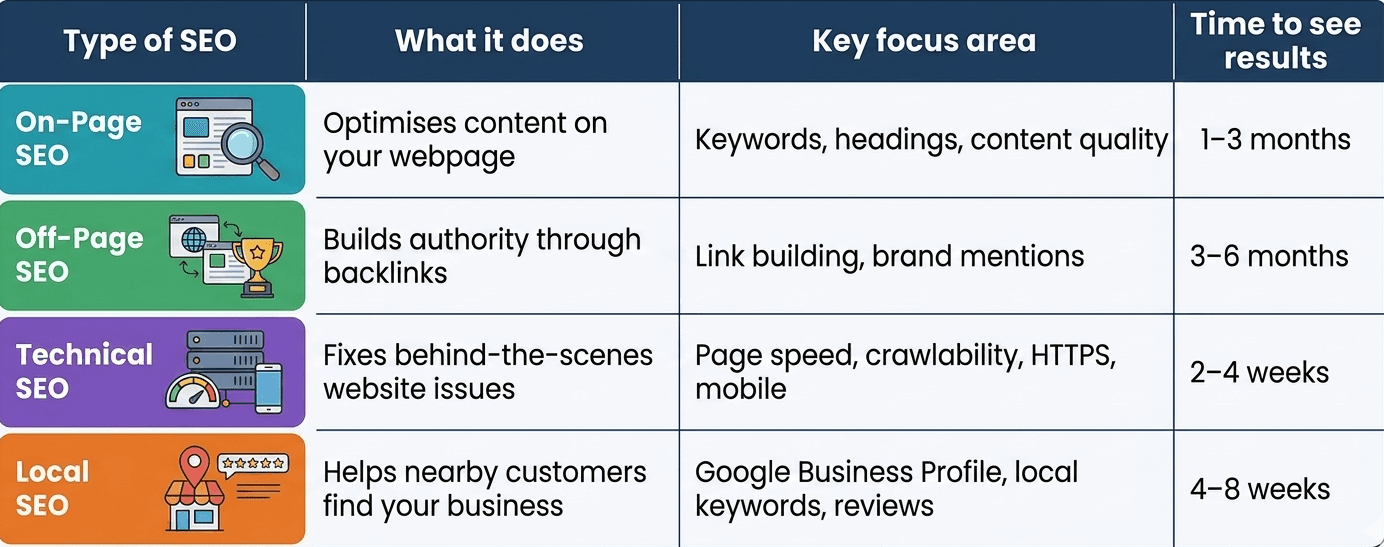
SEO is not just one single activity. It has different parts that work together like a team, each playing its own important role to help your website rank higher on Google.
Think of it like building a strong house. You need a good foundation (Technical SEO), beautiful interiors that people love (On-Page SEO), a solid reputation in the neighbourhood (Off-Page SEO), and a visible address board that locals can easily find (Local SEO). When all these parts work together, your website becomes much stronger and more likely to appear in search results.
Here are the main types of SEO explained in very simple language with examples so you can clearly see how they connect in real life.
On-Page SEO
On-Page SEO means optimising everything that appears directly on your webpage.
In simple words, it's like cleaning, decorating, and arranging the inside of your house so that when guests (and Google) arrive, they feel welcomed, find what they need quickly, and want to stay longer.
The key things you can do: start by writing clear, attractive page titles and headings that include your main keywords naturally. Create helpful, easy-to-read content that directly answers what people are searching for. Add relevant images with proper file names and alt text - for example, use "ginger-chai-dehradun.jpg" instead of something generic like "img001.jpg." Finally, organise the page well with short paragraphs, bullet points, and subheadings so it feels easy to read on any device.
Real Example: Suppose you have a page about "digital marketing." With good on-page SEO, you would put the phrase naturally in the title, introduction, and headings. You write the content like you're explaining it to a friend over chai - simple, helpful, and engaging. As a result, readers spend more time on the page, Google notices this positive behaviour, and your page starts ranking better. On-Page SEO is usually the easiest and fastest place for beginners to start seeing improvements.
TIP - Quickest on-page win:
Rewrite the title tag of your 3 most important pages. Put your main keyword in the first 60 characters and make it genuinely compelling to click. This single change can improve click-through rates within days - and it's the very first thing Google reads on any page.
Off-Page SEO
Off-Page SEO is everything that happens outside your website that helps improve its reputation and visibility.
Simply put, it's about building trust and authority by getting other respected websites to mention or link back to you. These links act like votes of confidence - the more quality votes you earn, the more Google believes your site is trustworthy and shows it higher in the results.
Basic ways to do this include writing guest articles for other relevant blogs, getting listed on good directories or resource pages, and creating shareable content that people naturally want to link to.
Real Example: Imagine you run a small chai stall in Dehradun. A popular local food blog writes an article on "best chai places in Dehradun" and includes a link to your recipe page. Google sees this as a positive signal from a relevant website and may start ranking your page higher for searches like "ginger chai Dehradun." This type of SEO takes more time and effort, but it builds long-lasting authority that keeps paying off for months or even years.
WARNING - Never buy cheap backlinks.
Services that sell "500 backlinks for ₹500" use spam networks that Google actively penalises. A single penalty can remove your site from search results entirely. Build links slowly and naturally - one backlink from a real, relevant website is worth more than a hundred from link farms. Patience here protects everything else you build.
Technical SEO
Technical SEO is the behind-the-scenes work that helps search engines crawl, understand, and index your website properly.
In simple terms, it's like making sure the foundation, wiring, and doors of your house are strong and well-maintained so that guests (and Google's robots) can enter easily, move around without problems, and enjoy the experience.
You don't need to be a tech expert many free tools make it manageable even for beginners.
The key basics include:
- Making your website load quickly (ideally under 3 seconds)
- Ensuring it works perfectly on mobile phones
- Creating a sitemap (like a roadmap for Google's bots)
- Using secure HTTPS
- Fixing any broken links
Simple Scenario: Imagine your website is a shop in a busy market. If the door is locked, the shelves are messy, and the lights are off, customers (and Google) get frustrated and leave quickly. Technical SEO fixes all that - it opens the doors wide, organises everything neatly, and makes the shop fast and welcoming.
TIP:
Go to PageSpeed Insights (pagespeed.web.dev) and test your homepage on mobile. Google's mobile speed score is the single most actionable technical metric for most small business sites. Fix the top 2–3 issues it highlights and you'll see measurable improvements in both speed and rankings, often within 2–4 weeks.
Local SEO
Local SEO is the process of optimising your online presence so that people in your city or nearby areas can easily find your physical business when they search on Google.
In simple words, it helps your shop, restaurant, clinic, or service business appear in local search results - especially when someone types phrases like "near me", "in Dehradun", or "close by." This is one of the most powerful types of SEO for small and local businesses in India because most customers search for services nearby on their phones.
The most important tool for Local SEO is Google Business Profile (previously known as Google My Business). It's like your business's free digital storefront on Google Maps and search results.
Here's what you should do to get started:
- Claim and fully set up your Google Business Profile with accurate name, address, phone number, timings, and services
- Add high-quality photos of your shop, products, and team
- Encourage satisfied customers to leave positive reviews
- Use local keywords naturally, such as "digital marketing agency Dehradun", "best chai stall Dehradun", or "AC repair near me"
Real-Life Example: Imagine it's 9 PM and someone's air conditioner suddenly stops working. They search "AC repair near me" on Google. If your business has a well-optimised Google Business Profile, your shop will appear with your location pin, rating, contact number, and working hours. The customer sees you as trustworthy and convenient, so they call you right away. Many local businesses get their first customers through Local SEO faster than any other method.
DID YOU KNOW?
46% of all Google searches have local intent - people are looking for something nearby
76% of people who search for a local business on their phone visit within one day
Setting up your Google Business Profile costs nothing and takes under an hour. It is the single highest-return first step for any local business in India.
Keyword Research and Search Intent
Keyword Research is the process of discovering the exact words and phrases that people type into Google when they are looking for information, products, or services.
Search Intent means understanding the reason behind the search - what the person actually wants to achieve when they type something into Google.
Think of keyword research and search intent like being a smart shopkeeper in a busy Dehradun market. Instead of shouting random offers, you first listen carefully to what customers are asking for. You understand their real need (Are they just curious? Comparing options? Or ready to buy right now?). Then you arrange your stall and signboard to match exactly what they want. When you do this well, more customers come to you happily and trust you.
In simple words, keyword research helps you find the right "search phrases" to focus on, while search intent helps you create content that perfectly matches what the searcher needs. For beginners, start simple - just type your topic into Google and note the suggestions that appear. You can also use Google's free Keyword Planner tool.
The 4 Types of Search Intent:
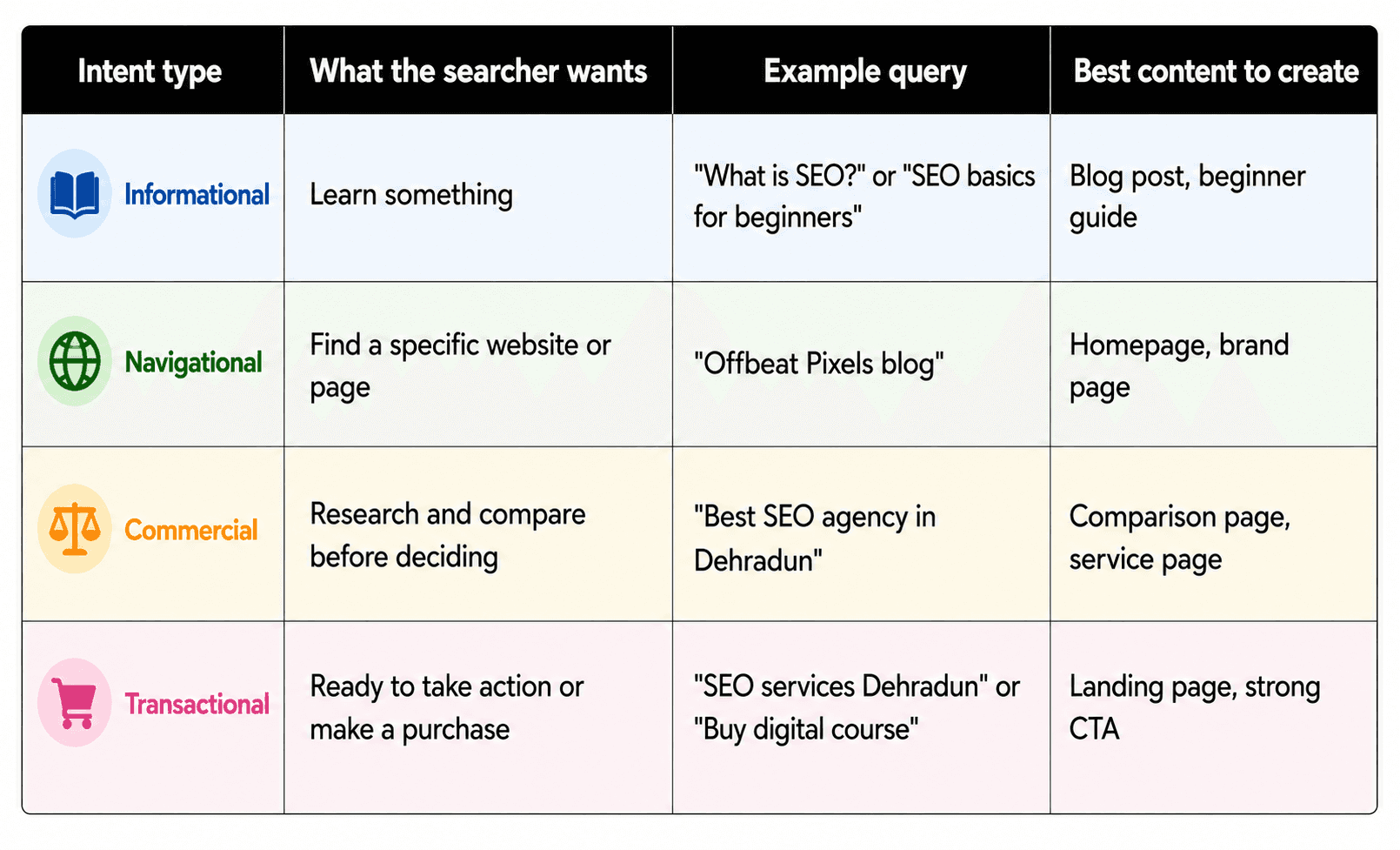
Real-Life Example: Imagine someone searches "SEO basics for beginners." Their intent is informational - they want an easy, friendly guide like this one, not a sales pitch. But if they search "best SEO guide for beginners review," their intent is commercial - they are comparing different options before choosing one. When your content matches their exact need, Google sees that readers are happy and staying longer, and rewards your post with better rankings.
TIP - Focus on long-tail keywords first.
Long-tail keywords are longer, more specific phrases like "SEO guide for beginners in India" or "fundamentals of SEO explained simply." They have lower competition and bring more targeted visitors to your site. A new website should target these before attempting broader terms like "SEO guide" which are dominated by high-authority sites with years of history.
Free tool: type your topic into Google and look at the "People also ask" and "Related searches" sections at the bottom - these are real questions your audience is already asking, completely free.
SEO Content Strategy
SEO Content Strategy is the plan for creating and managing helpful content on your website that both people and search engines love.
In simple words, it's about writing articles, guides, or pages that solve real problems for your audience while naturally including the right keywords.
Why It Is Important?
A good content strategy is the heart of modern SEO. Search engines like Google now reward websites that provide genuine value to readers. When people stay longer, read more, and share your content, Google sees your site as trustworthy and ranks it higher. It also helps turn visitors into loyal readers and future customers. Without it, even the best technical SEO or backlinks won't work well.
Think of content strategy like running a popular chai stall in Dehradun. You don't just sell chai - you offer free ginger tea recipes, tips on the perfect masala, and stories behind your ingredients. People come for the free value, enjoy the experience, trust your brand, and eventually become regular paying customers. The same happens online.
Example: Instead of writing a salesy page that says "Hire us for SEO," create a helpful article like this SEO guide for beginners. Readers finish the post feeling smarter, trust your brand more, and are more likely to reach out later when they need help. The golden rule is to write for humans first - Google will notice the engagement and rank you better.
SEO Audits and Reporting
SEO Audit is a thorough health check-up of your website to find what's working well and what needs improvement for better search rankings.
SEO Reporting means regularly tracking and understanding simple numbers that show how your website is performing in search results.
Why It Is Important?
Even the best websites can develop small problems over time like slow loading pages, broken links, and outdated content. Regular audits help you catch and fix these issues before they hurt your rankings. Reporting shows you what's actually bringing results so you can focus your time and effort on the right things. For beginners, this prevents wasted effort and helps you see steady progress.
Think of SEO audits and reporting like taking your scooter for regular servicing. You don't wait for it to break down completely. A good mechanic checks the engine, tyres, brakes, and oil. In the same way, an SEO audit checks your website's speed, mobile-friendliness, links, and content quality so it keeps running smoothly and taking you (and your customers) to the right destination.
Simple Audit Checklist for Beginners:
- Check if all pages are loading fast
- Look for broken links or errors
- Ensure titles, headings, and descriptions are clear and keyword-friendly
- Confirm the site is fully mobile-friendly
Use free tools such as Google Search Console (which shows how Google sees your site) and Google Analytics (which tracks visitor behaviour). For reporting, keep an eye on simple metrics like organic traffic (visitors from Google), your keyword rankings, and bounce rate (how quickly people leave).
Real-Life Example: After optimising one page with better titles and content, you run a quick audit in Google Search Console. You notice that page has started ranking for "fundamentals of SEO." That's a clear win! You make a note of what worked, apply the same changes to other pages, and see your traffic grow steadily over time.
Common SEO Myths
Let's quickly bust some popular myths so you don't waste time on the wrong things.
Myth: SEO gives quick results.
Truth: It usually takes 3–6 months of consistent effort.
Myth: You just need to stuff keywords everywhere.
Truth: Google penalises this - only natural, helpful writing wins.
Myth: Only backlinks matter.
Truth: Content quality, technical setup, and user experience are all equally important.
Myth: SEO is dead because of AI.
Truth: It's evolving, but high-quality content is needed more than ever. Google's AI Overviews still pull from well-written, properly indexed pages.
Conclusion
Congratulations! You've now covered the fundamentals of SEO through this complete SEO guide for beginners. Remember - SEO is not magic. It's about being genuinely helpful, making your website easy to use, and improving it steadily over time.
Start small today: pick one page, sharpen its title and first paragraph to match what your audience is actually searching for, and set up your Google Business Profile if you haven't already. These SEO basics compound quietly - three months from now, you'll be glad you started today.
A few things worth bookmarking as your next steps:
- Run a free audit on your site using Google Search Console - it shows exactly what Google sees and where you're losing clicks
- Check your page speed on PageSpeed Insights - a slow mobile experience is the fastest way to lose rankings you've earned
- Research 10 realistic long-tail keywords for your business using Google's free Keyword Planner
SEO rewards patience and consistency more than any single tactic. Build on solid basics, keep improving, and the results follow.
This guide was written by the team at Offbeat Pixels best digital marketing company in India.
References:
- 68% of online experiences begin with a search engine
BrightEdge — https://videos.brightedge.com/research-report/BrightEdge_ChannelReport2019_FINAL.pdf - Only 0.63% of searchers click on page 2
Backlinko — https://backlinko.com/google-ctr-stats - 53% of all website traffic comes from organic search
BrightEdge — https://videos.brightedge.com/research-report/BrightEdge_ChannelReport2019_FINAL.pdf - 46% of all Google searches have local intent
Search Engine Roundtable — https://www.seroundtable.com/google-46-of-searches-have-local-intent-26529.html - 76% of people who search nearby visit a business within a day
Think with Google — https://www.thinkwithgoogle.com/consumer-insights/consumer-trends/mobile-search-trends-consumers-to-stores/