What Is 'Share of Model'? The New Metric Replacing Keyword Rankings
Something's changed, and most businesses haven't noticed yet
Think about the last decision you made - a doctor, a contractor, a place to invest. Did you actually Google it and scroll through ten blue links? Or did you just ask an AI tool and go with whatever it told you?
If it's the second one, you're in good company.
Roughly half of consumers are already using AI-powered search, and McKinsey expects it to influence somewhere around $750 billion in revenue by 2028.
The way people find businesses is shifting quietly under our feet, and honestly, the old way of measuring "are we visible online" just doesn't hold up the same way anymore.
That's where a new idea comes in: Share of Model.
Okay, but what does it actually mean?
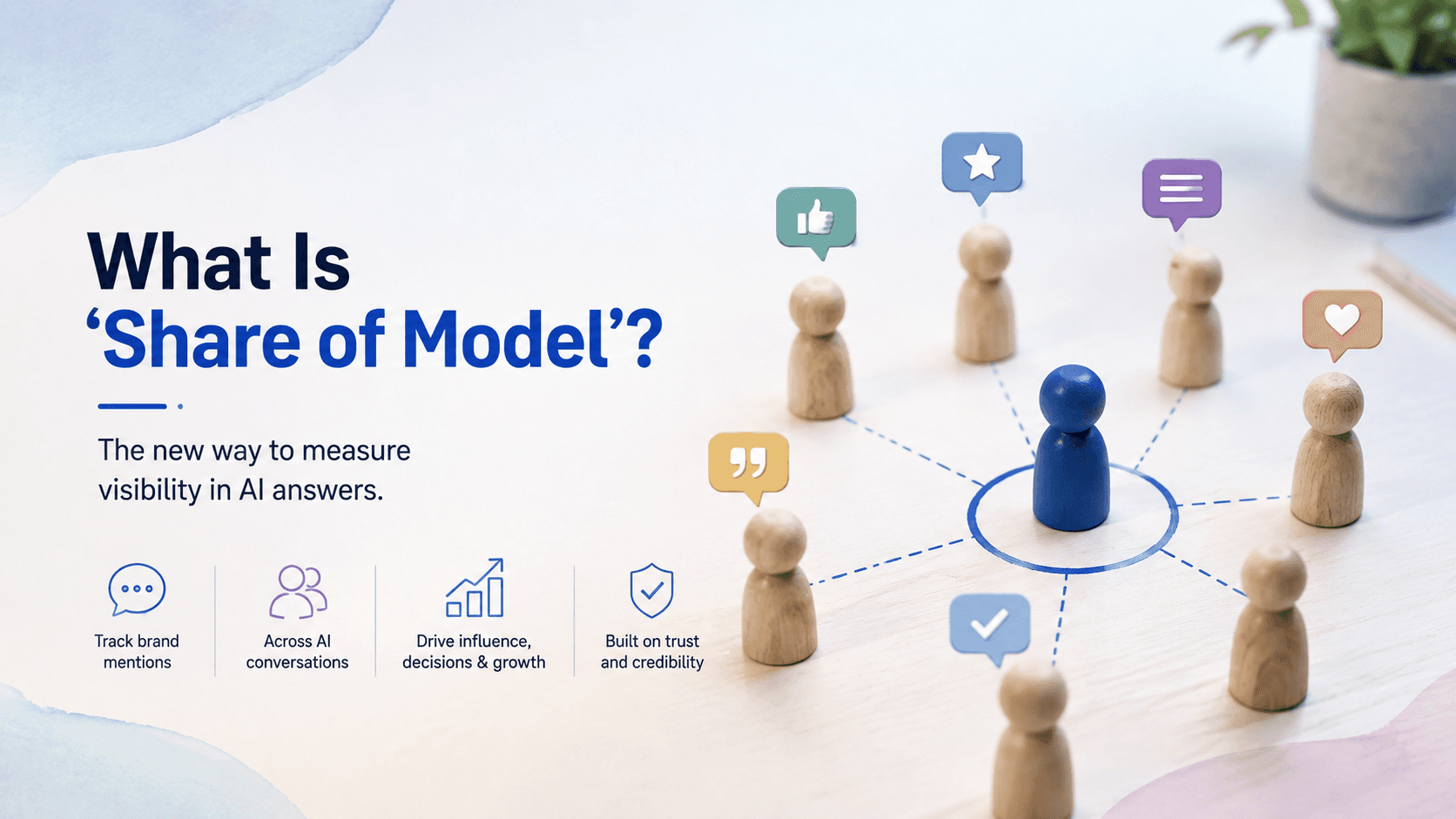
Put simply, Share of Model is your brand's odds of showing up when someone asks an AI tool a question in your category.
It's not "do you rank on Google" anymore. It's "does ChatGPT, Gemini, or Claude actually mention you when someone asks for a recommendation?"
Think of it like share of voice in advertising, just for AI answers instead of ad space.
Say ten different people ask an AI assistant "who's a good real estate advisor near me." Share of Model is simply - out of those ten conversations, how many mention you?
Why it's not the same game as ranking #1
Rankings used to feel almost comforting in how simple they were - you were either on page one, or you weren't. Share of Model doesn't work like that at all:
- It's probabilistic, not fixed. There's no "position one" you get to permanently claim.
- A brand might show up in 80% of AI answers to one question, and barely 20% for a nearly identical one right next to it.
- It measures something website analytics simply couldn't before - whether you even crossed someone's mind during a conversation they may never click through from at all.
There's no finish line here to cross and relax. It's more like a reputation that has to keep earning itself, one conversation at a time.
Why this is moving faster than most people realise
A few numbers worth sitting with:
- ChatGPT now has around 883 million monthly users, and Google's AI Overviews already show up in nearly half of all searches.
- Over 900 million people use ChatGPT weekly, and more than a third of consumers are starting their searches with AI instead of Google now.
- Search traffic itself is expected to drop 25% by 2026, even as the people who do arrive through AI convert at a noticeably higher rate.
And here's the part that really changes things:
AI tools don't hand you a list of ten options the way Google does - they just pick one, and explain why.
Ranking #3 on Google used to still get you clicks. Being the "third choice" an AI quietly considers, but never actually says out loud? That gets you nothing.
So how do you actually earn a place in the answer?
Not by stuffing keywords - that game's mostly played out. What actually moves the needle now:
- Genuine mention frequency and consensus across the internet, not backlinks, is what's driving visibility these days.
- Third-party mentions are now roughly 3x more correlated with AI visibility than traditional backlinks.
- Consistency matters - how often you're cited, and how many credible sources are telling the same story about who you are.
In other words, it rewards honesty and consistency more than clever tricks. Which, if you really think about it, is kind of refreshing.
Does this mean SEO is dead?
No, think of it as a new layer on top, not a replacement.
- SEO is still necessary. It's just no longer enough on its own.
- Ranking well on Google doesn't even guarantee you'll show up in an AI answer — the two don't move together quite the way you'd expect.
Where this leaves us:
If you're not in the model's answer, you're simply not part of the moment someone actually makes their decision.
That's the quiet, uncomfortable truth sitting underneath this whole shift. It's not loud, it's not dramatic - but it's already reshaping who gets chosen, and who gets forgotten.
The businesses that get ahead of this won't be the ones with the flashiest website. They'll be the ones who were already being talked about honestly, consistently, everywhere long before anyone even typed the question into an AI tool at all.