What Is Off-Page SEO? Common Mistakes That Hurt Your Rankings
96.55% of web pages get zero organic traffic from Google. The leading cause is not bad writing or a slow website. It is zero authority.
Before You Start Reading:
If you are completely new to SEO and Digital marketing, we strongly recommend reading our Digital Marketing guide and Fundamentals of SEO Explained: Complete SEO Guide for Beginners first. It will give you the foundation to understand everything in this article much better. You will get ten times more value from this guide.
What Is Off-Page SEO?
Off-page SEO refers to all optimisation activities that happen outside of your own website with the goal of improving your position in search engine results. It includes link building, digital PR, social signals, local citations, and brand reputation management.
Think of your website like a new doctor who just opened a clinic in your city. On-page SEO is the degree certificate on the wall - it tells people what the doctor specialises in. Off-page SEO is the word-of-mouth from satisfied patients, the referral from a trusted senior doctor, and the mention in a local health magazine. No matter how qualified the doctor is, without those external endorsements, new patients have no reason to walk in. Google works the same way - it looks outside your website to decide how much to trust what's inside it.
To understand it simply: if on-page SEO is what you say about yourself, off-page SEO is what others say about you. Google trusts third-party signals far more than self-promotion just as you would trust a review on Google over a company's own tagline.
A Real-World Example
Consider two competing digital marketing agencies in Jaipur. Both have well-structured websites with strong service pages. Agency A has been featured in YourStory has earned links from two startup blogs, has 90 verified Google reviews, and is listed on DesignRush. Agency B has none of these. Even if Agency B's website loads faster and has better-written content, Agency A will rank significantly higher because the broader internet has publicly endorsed it.
DID YOU KNOW?
96.55% of all web pages get zero organic traffic from Google - the leading cause is having no backlinks pointing to them (Ahrefs, 2023)
The #1 result on Google has an average of 3.8x more backlinks than the pages ranking in positions 2 through 10 (Backlinko, 2020)
Websites with a higher number of unique referring domains consistently hold higher ranking positions across competitive keywords (Moz, 2023)
Why Is Off-Page SEO Important?
Publishing great content without off-page SEO is like opening a shop in a city and telling nobody about it. Google cannot walk into your office, speak to your customers, or verify your credentials in person. It relies on the rest of the internet to answer one question on your behalf: does this website deserve to be trusted?
Off-page SEO is your answer to that question.
It Proves Trustworthiness to Search Engines
Google's evaluation of any website is guided by its E-E-A-T framework ( Experience, Expertise, Authoritativeness, and Trustworthiness). Of these four signals, three are primarily validated through off-page signals. When reputable websites link to yours, when journalists quote your content, when customers leave verified reviews - these external signals are what confirm to Google that your site is genuinely trustworthy, not just technically optimised.
It Builds Authority That Compounds Over Time
Unlike a paid ad that stops performing the moment you stop paying, off-page authority accumulates. A backlink you earn today continues passing authority to your domain for years, as long as the linking page stays live. A site that consistently earns quality links over 12 months will have a compounding authority advantage over a competitor who starts the same activity 6 months later the gap widens every week.
It Unlocks Rankings for Competitive Keywords
Long-tail, low-competition keywords are winnable through strong on-page SEO alone. But for any keyword with real commercial value "best CA firm in Delhi," "content marketing agency India," "wedding photographer Udaipur" domain authority built through off-page signals determines who wins. Google uses backlink profile strength as a tiebreaker when two pages are roughly equal in content quality.
It Sends Referral Traffic That Converts
Every quality backlink is also a live traffic source. A link from a popular industry newsletter, a high-traffic blog, or a business directory does not only send an authority signal to Google it sends actual visitors. Referral traffic from trusted sources tends to convert at a higher rate than cold organic traffic because the visitor arrives with a degree of pre-existing trust.
WARNING - Black-Hat Link Building
Services offering 500 backlinks for ₹500 use private blog networks, link farms, and spam directories that Google's Penguin algorithm is specifically built to detect. A single manual action from Google's spam team can remove your website from search results entirely - sometimes taking 6 to 12 months to recover from, even after the bad links are removed. Never outsource link building to any service that cannot name the specific websites where your links will appear.
TIP:
Set up a free Google Alert for your brand name. Any website that mentions your business without linking to it is a warm outreach opportunity - they already know who you are. A polite, one-paragraph email asking them to add a link converts at a surprisingly high rate and costs nothing but a few minutes of your time.
Difference between On-Page SEO vs. Off-Page SEO
On-page SEO and off-page SEO are not competing strategies. They are two halves of the same system.
On-page SEO ensures your content is relevant and technically sound. Off-page SEO ensures the wider internet recognises your authority. A website with strong on-page SEO but no off-page signals cannot rank for competitive terms. A website with strong off-page authority but poor on-page structure wastes the authority it has earned.
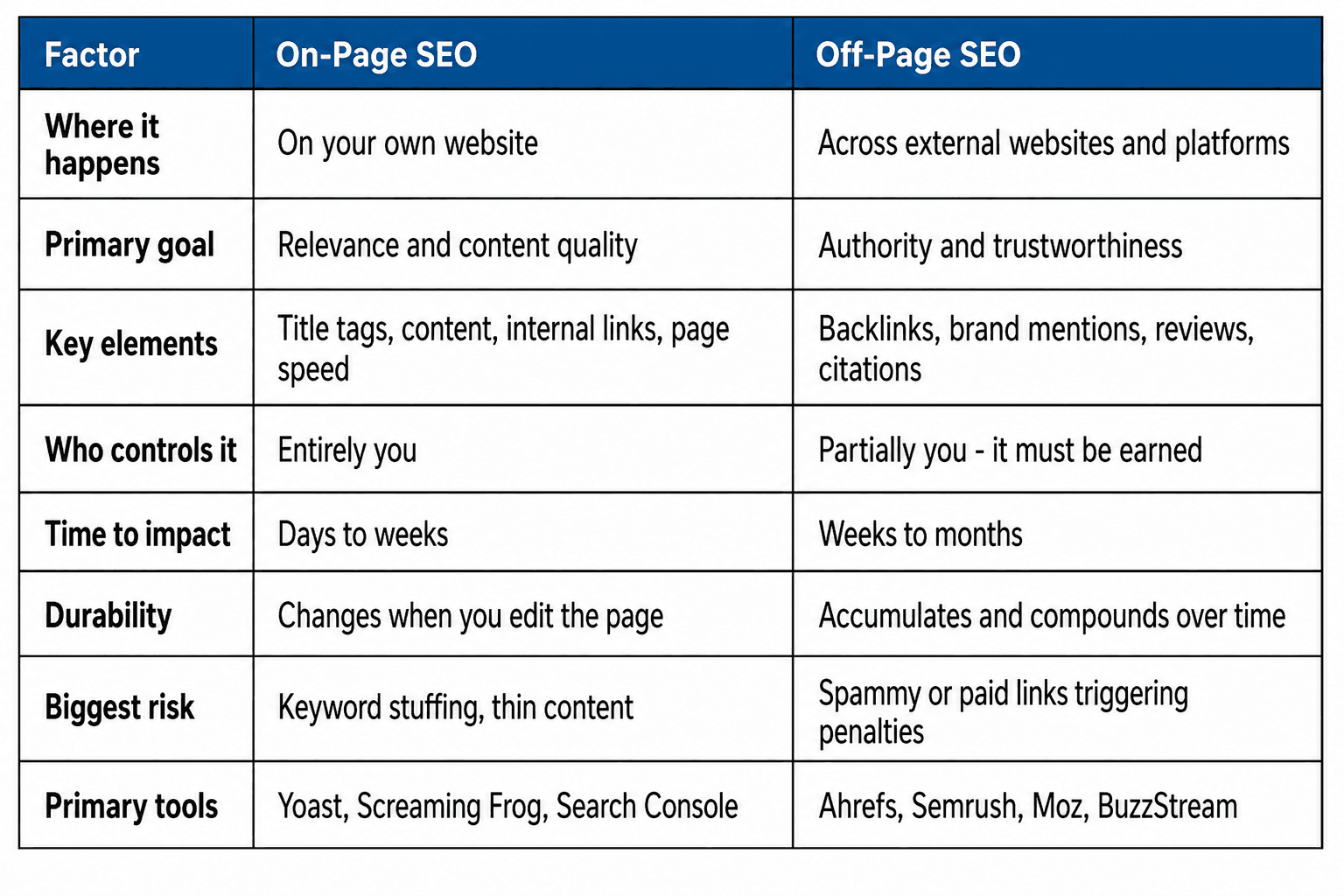
| Factor | On-Page SEO | Off-Page SEO |
| Where it happens | On your own website | Across external websites and platforms |
| Primary goal | Relevance and content quality | Authority and trustworthiness |
| Key elements | Title tags, content, internal links, page speed | Backlinks, brand mentions, reviews, citations |
| Who controls it | Entirely you | Partially you - it must be earned |
| Time to impact | Days to weeks | Weeks to months |
| Durability | Changes when you edit the page | Accumulates and compounds over time |
| Biggest risk | Keyword stuffing, thin content | Spammy or paid links triggering penalties |
| Primary tools | Yoast, Screaming Frog, Search Console | Ahrefs, Semrush, Moz, BuzzStream |
How They Work Together - A Practical Example
Imagine you publish a guide called "How to File ITR for Freelancers in India." The page is keyword-optimised, loads in under 2 seconds, and has clear headings - that is your on-page SEO doing its job. But if no other website links to it, Google has no external reason to rank it above the dozens of similar guides already published by Cleartax, ClearTax, and established finance portals with years of authority behind them.
Now suppose a popular CA blog references your guide. A freelancer community on Reddit links to it. A fintech newsletter includes it in their weekly roundup. These external signals confirm to Google that your guide is worth ranking. On-page got the page ready. Off-page got it found.
TIP:
For new websites, spend the first 60 to 90 days building on-page foundations: fast load times, well-structured content, clear title tags, proper internal linking. Then shift focus to off-page. Trying to earn backlinks before your on-page house is in order means sending high-quality referral traffic to a poor experience and wasting the authority those links pass.
Types of Link Building
Not every backlink is earned the same way. There are few different types of link building methods, each suited to different industries, budgets, and content types. A strong off-page strategy uses several of these in parallel not just one.
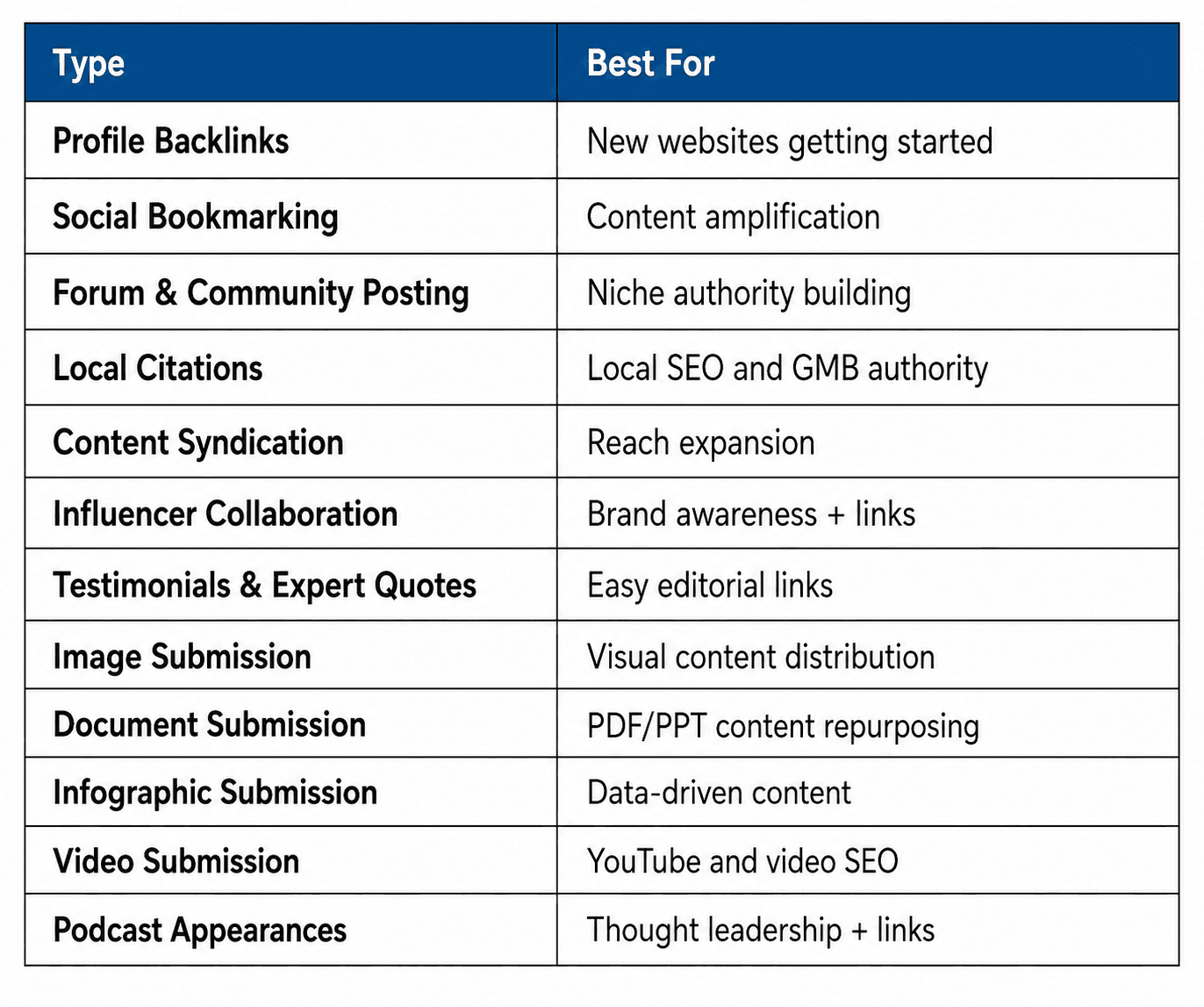
| Type | Best For |
| Profile Backlinks | New websites getting started |
| Social Bookmarking | Content amplification |
| Forum & Community Posting | Niche authority building |
| Local Citations | Local SEO and GMB authority |
| Content Syndication | Reach expansion |
| Influencer Collaboration | Brand awareness + links |
| Testimonials & Expert Quotes | Easy editorial links |
| Image Submission | Visual content distribution |
| Document Submission | PDF/PPT content repurposing |
| Infographic Submission | Data-driven content |
| Video Submission | YouTube and video SEO |
| Podcast Appearances | Thought leadership + links |
1. Profile Backlinks
Profile backlinks submission are links created by completing your business or personal profile on third-party platforms - such as Crunchbase, LinkedIn, AngelList, GitHub, or industry-specific directories. When you fill in the website field on these profiles, the platform typically generates a backlink to your domain.
These are among the easiest links to acquire and are a sensible starting point for brand-new websites that have zero backlink profile. However, they carry relatively low authority on their own and should be treated as a foundation layer, not a primary strategy. Aim to build profiles on platforms that are genuinely relevant to your industry.
2. Social Bookmarking
Social bookmarking submission is the practice of submitting your content to platforms where users save, tag, and share web pages they find valuable - examples include Reddit, Mix, Scoop.it, and Flipboard. When your content is saved or upvoted on these platforms, it generates referral traffic and, in some cases, a backlink.
Social bookmarking links are typically nofollow (they do not pass direct ranking authority to your site), but the referral traffic and increased content visibility can indirectly lead to genuine dofollow backlinks from people who discover your content through these platforms. Focus on platforms where your target audience is genuinely active, rather than submitting to dozens of irrelevant bookmarking sites.
3. Forum & Community Posting
Forum and community posting involves participating in discussions on platforms like Reddit, Quora, niche forums, Facebook Groups, and LinkedIn Groups and where relevant and helpful, linking back to your content as a resource.
The key word is "relevant and helpful." Google and forum moderators both penalise users who drop links without adding value to the conversation. The right approach is to spend time genuinely answering questions, building reputation, and only linking to your content when it directly answers what someone has asked. Communities like Quora have domain authorities above 90 a well-placed answer with a contextual link can pass meaningful authority and drive consistent referral traffic for years.
4. Local Citations
A local citation is any online mention of your business's Name, Address, and Phone number (NAP) - on directories, local listing sites, map platforms, and review sites. Examples include JustDial, Sulekha, IndiaMART, Google Business Profile, Bing Places, and Apple Maps.
Citations are a foundational local SEO signal. Google cross-references your NAP information across multiple platforms to verify that your business is legitimate and accurately located. Inconsistent NAP data - your address written differently across directories confuses Google's verification process and directly weakens your local rankings.
Consistency is the most important citation rule: every listing must show your business name, address, and phone number in exactly the same format.
5. Content Syndication
Content syndication is the process of republishing your original article or blog post on third-party platforms - such as Medium, LinkedIn Articles, YourStory, or industry-specific publications to reach a wider audience. The syndicated post typically includes a canonical tag or a credit link pointing back to the original article on your website.
When done correctly, syndication expands your content's reach without cannibalising your original page's rankings. The canonical tag tells Google which version of the content is the primary source, ensuring your original page gets the ranking credit. Medium and LinkedIn both have high domain authority - a syndicated article on either platform can generate backlinks when other writers reference it, and it positions your brand as a credible voice in your space.
6. Influencer Collaboration & Reviews
Influencer collaboration involves partnering with content creators, bloggers, or industry experts in your niche to review your product, mention your brand, or co-create content resulting in a backlink from their website or platform to yours.
The most valuable influencer links come from bloggers and niche creators who have a dedicated, engaged audience and their own website with real domain authority not just a large social media following.
Reach out to micro-influencers (5,000 to 100,000 followers) in your specific niche: their audiences are more targeted, their endorsements feel more genuine, and their collaboration fees are significantly lower than macro-influencers. Always ensure any sponsored content is disclosed transparently to comply with ASCI guidelines in India.
7. Testimonials & Expert Quotes
Testimonial link building is the practice of providing a genuine, well-written testimonial or expert quote to a brand, tool, or service you have actually used - in exchange for them publishing it on their website with a link back to yours.
Companies love testimonials because they build trust with their own potential customers. Many businesses actively display client testimonials on their homepage or a dedicated page with a credit link. Identify 10 to 15 tools, software products, or services you legitimately use in your work, reach out offering a testimonial, and ask that they credit your website. This is one of the highest-converting, lowest-effort link building tactics available and the links tend to sit on high-authority homepages.
8. Image Submission
Image submission is the process of uploading original, high-quality images like product photos, branded graphics, infographics, or illustrations to image-sharing platforms such as Flickr, Pinterest, Imgur, DeviantArt, or Wikimedia Commons, with a link back to your website in the image description or profile.
The most practical application of image submission for most businesses is Pinterest, which has a domain authority above 90 and drives significant referral traffic in visual industries such as fashion, food, interior design, travel, and weddings. Images with descriptive alt text and strategic keyword-rich captions also contribute to image search visibility. Ensure all submitted images are your own original work and are not subject to third-party copyright.
9. Document Submission (PDF, PPT, DOC Sharing)
Document submission involves uploading original written content - reports, guides, whitepapers, presentations, or case studies - in file formats such as PDF, PPT, or DOC to platforms like SlideShare, Scribd, Academia.edu, or Issuu, with your website URL embedded in the document and profile.
SlideShare, owned by LinkedIn, is the most powerful of these platforms for B2B businesses it has a domain authority above 90 and receives millions of monthly visitors searching for industry reports and presentations. Repurpose your best-performing blog posts or data studies into downloadable PDFs and upload them with a compelling cover, your brand logo, and a clear call to visit your website for the full resource.
10. Infographic Submission
Infographic submission is the process of creating a visual representation of data, a process, or a concept and distributing it across infographic-specific directories and platforms - such as Visual.ly, Infogram, Pinterest, and Reddit's data visualisation communities with an embed code that links back to your original page.
Infographics earn backlinks passively when other bloggers or publications embed your infographic in their own content, the embed code typically contains a link back to your website. A single well-researched, visually compelling infographic on a topic where data is hard to find can continue earning backlinks for years after its original publication. Always include your brand name, website URL, and data sources visibly within the infographic itself.
11. Video Submission
Video submission involves uploading original video content to video-sharing platforms primarily YouTube, but also Vimeo, Dailymotion, and Wistia - with your website URL embedded in the video description, pinned comment, and channel profile.
YouTube is the world's second largest search engine and has a domain authority of 100. A well-optimised video with a keyword-rich title, detailed description, and clear timestamps can rank both on YouTube and in Google's video results - driving views, brand awareness, and referral traffic back to your website. Include a clear verbal call to action within the video directing viewers to a specific page on your site, and always include a clickable link in the first two lines of the description (before the "Show More" fold).
12. Podcast Appearances & Audio Submission
Podcast submission appearances involve reaching out to podcast hosts in your industry and offering yourself as a guest expert - discussing your area of knowledge in exchange for a mention and link to your website in the episode show notes. Audio submission extends this to uploading your own podcast episodes to directories such as Apple Podcasts, Spotify and amazon music.
Podcast show notes on the host's website often carry genuine editorial backlinks - the host is actively curating a resource for their audience and your link appears within that context. Beyond the backlink, podcast appearances deliver brand exposure, establish thought leadership, and introduce your business to highly engaged, niche audiences. Prepare a strong 2-paragraph pitch that highlights your specific expertise, the topic you could cover, and why it would serve the podcast's specific audience.
Off-Page Ranking Factors - What Google Looks at Beyond Your Website
Off-page SEO ranking factors are all the external signals that search engines evaluate to decide how authoritative, trustworthy, and relevant your website is compared to competitors.
These signals exist outside the pages of your own website on other websites, directories, social platforms, review sites, and across the wider internet.
Think of your website like a candidate applying for a job. Your on-page SEO is your resume - it tells the employer what you can do. Your off-page ranking factors are your references, your reputation, your LinkedIn recommendations, and the awards you have received. No matter how well-written your resume is a candidate with strong external endorsements will almost always get the interview first. Google thinks the same way, it weighs what others say about you far more heavily than what you say about yourself.
Off-Page Ranking Factors:
Off-page ranking factors fall into three major pillars:
- Link building
- Content marketing
- Local SEO
Each pillar feeds a different type of authority signal into Google's ranking algorithm.
1. Link Building
Link building is the process of earning hyperlinks from external websites that point back to your own. Each link acts as a vote of confidence - telling Google that another website found your content credible enough to recommend to its own readers.
Think of link building like academic citations. When a professor's research paper is cited by dozens of other researchers, it signals that the work is trustworthy and important. When your web page is linked to by dozens of relevant, authoritative websites, Google treats it the same way, your page must be worth referencing.
DID YOU KNOW?
- The #1 ranking page on Google has an average of 3.8x more referring domains than pages ranked in positions 2 through 10 (Backlinko, 2020)
- 96.55% of all web pages get zero organic traffic from Google - the primary reason is having no backlinks (Ahrefs, 2023)
- Pages that rank on page one have significantly higher domain ratings than pages on page two (Semrush Ranking Factors Study, 2024).
Quality Links
Not all links carry equal value. A single backlink from a high-authority, relevant website is worth far more than 100 links from unrelated directories. Google evaluates link quality based on three factors:
- The authority of the linking domain
- The topical relevance of the linking page to your own content
- The editorial context whether the link was placed naturally within genuine content or stuffed into a footer or sidebar.
A link from a well-known industry publication, a respected news site, or a government or educational domain (.gov, .edu) passes significantly more authority than a link from a general article directory. Focus your outreach on websites your target audience already reads and trusts.
WARNING - Quantity Without Quality Is Dangerous
A sudden spike in low-quality links - especially from unrelated foreign websites, link farms, or paid link schemes - can trigger Google's Spam algorithm or earn a manual action from Google's spam review team. Both can remove your website from search results entirely. Always prioritise relevance and editorial quality over link volume.
Anchor Text
Anchor text is the visible, clickable text of a hyperlink - for example, the words " SEO guide for beginners" in a sentence that links to page. Google reads anchor text as a strong signal of what the linked page is about, which is why it plays a direct role in how your page ranks for specific keywords.
There are four anchor text types to know:
- Exact match (the anchor text matches your target keyword exactly - e.g., "link building services")
- Broad match (includes the keyword plus other words - e.g., "link building services for startups")
- Branded (uses your brand name - e.g., "SearchEdge Digital")
- Naked URLs (the full URL is the anchor - e.g., "https://searchedge.in")
A natural, healthy backlink profile contains a mix of all four types. A profile dominated by exact match anchors is a red flag to Google and can result in a penalty.
TIP - The 70/20/10 Anchor Text Rule
Aim for roughly 70% of your backlinks to use branded or naked URL anchors, 20% to use partial match or generic anchors ("click here," "read more," "this article"), and only 10% to use exact match keyword anchors. This distribution mimics how naturally occurring links appear across the web - and keeps your profile safe from algorithmic penalties.
Broken Link Building
Broken link building is the practice of finding hyperlinks on other websites that no longer work (because the page they linked to has been deleted or moved), creating content on your own site that serves the same purpose, and then reaching out to the website owner to suggest replacing the broken link with a link to your working page.
It works because website owners genuinely want to fix broken links - a broken link is a poor user experience for their own readers. You are not asking for a favour; you are offering a solution to a problem they already have. Tools like Ahrefs Site Explorer and Check My Links (a free Chrome extension) make it easy to find broken links on competitor pages or authoritative sites in your niche.
2. Content Marketing
Content marketing is the strategy of creating and distributing genuinely useful, original content - articles, videos, research, guides, tools to attract an audience and earn authority signals organically, without directly asking for links.
Think of content marketing like farming, not hunting. Link building through cold outreach is hunting you go after each link one at a time. Content marketing is farming - you plant seeds of useful content, tend them consistently, and over time they generate a harvest of inbound links, brand mentions, and social shares without you having to chase each one individually.
DID YOU KNOW?
- Content marketing costs 62% less than outbound marketing and generates approximately 3x more leads (DemandMetric, 2023)
- Long-form content of 3,000+ words earns 3.5x more backlinks than articles under 1,000 words (Backlinko, 2020)
- 70% of marketers say content marketing has become more important to their organisation in the past year (HubSpot State of Marketing Report, 2024)
Influencer Marketing
Influencer marketing in the context of off-page SEO means collaborating with creators who have an established, trusted audience to produce content that references or links to your brand. Unlike paid social media promotions, the focus here is on earning editorial placements - a review post on a blogger's website, a YouTube video that mentions your product with a link in the description, or an expert roundup where your brand is featured.
The SEO value comes from the backlink on the influencer's own domain, not from the social media post itself. Prioritise influencers who have a self-hosted website or blog with a genuine backlink profile, rather than those who only exist on Instagram or TikTok.
Guest Posting
Guest posting is the practice of writing and publishing original articles on other websites in your industry, websites that already have an established, relevant readership in exchange for a contextual backlink within the article or in your author bio.
A well-executed guest post on a high-authority industry website delivers three benefits simultaneously:
- Quality backlink
- Referral traffic
- Brand credibility
The golden rule of guest posting is to pitch genuinely useful, original content not thinly veiled promotional pieces. Editors at reputable publications reject self-promotional pitches immediately; the content must stand on its own journalistic or educational merit.
TIP - How to Find Guest Posting Opportunities
Search Google for: [your keyword] + "write for us", [your keyword] + "guest post guidelines", or [your keyword] + "submit an article." Build a shortlist of 20 to 30 publications, review their content quality and audience fit, then send personalised pitches with a specific article idea - not a generic offer to "write about anything."
Content Syndication
Content syndication as a content marketing tactic means distributing repurposed versions of your original content to wider publication platforms to extend its reach and capture new audiences. The key difference from simple republishing is strategic amplification choosing platforms where your target audience already exists.
Syndication works best when paired with a canonical tag or a "originally published at" credit link, which signals to Google that your domain is the original source. LinkedIn Articles, Medium, and YourStory are the three highest-value syndication platforms for Indian B2B and startup audiences respectively.
Forums
Forums as a content marketing channel rather than just a link building tactic - means becoming a genuinely active and recognised contributor to the communities where your potential customers ask questions and seek advice. Platforms like Quora, Reddit, and niche-specific communities on Discord or Slack all apply.
The content marketing approach goes beyond dropping links. It means building a recognisable profile over months, providing answers that other community members upvote and reference, and becoming known as a trusted voice before you ever mention your own brand or content. Quora answers that gain traction can rank independently in Google search results for specific questions - giving your brand a second point of presence on a SERP you may not be able to win with your own domain yet.
Digital PR
Digital PR is the practice of pitching newsworthy stories, original data, expert commentary, and creative campaigns to journalists, editors, and online publications with the goal of earning editorial coverage and authoritative backlinks from news sites and high-authority media outlets.
A single link from a major publication like The Hindu BusinessLine, Inc42, Economic Times, or YourStory carries more SEO weight than dozens of links from smaller blogs. Digital PR earns these links by offering journalists something genuinely useful: a data story they can report on, a fresh expert angle on a trending news topic, or a compelling human-interest story tied to your brand.
Social Media
Social media does not directly pass ranking authority to your website -Google has confirmed it does not consistently use social signals as a direct ranking factor. However, social media plays a critical indirect role in off-page SEO by amplifying your content to audiences that include writers, bloggers, and journalists who then link to it from their own websites.
A piece of research or a well-crafted article that earns significant organic shares on LinkedIn or Twitter is being shown to exactly the kinds of people who might embed it in their own content. Social media also drives branded search, when people see your brand name repeatedly on social platforms, they are more likely to search for it directly on Google, which is a trust signal Google does monitor.
3. Local SEO
Local SEO is the process of optimising your online presence so that your business appears in search results when people nearby search for the products or services you offer. This includes Google Maps results, the local 3-pack, and geo-targeted organic results.
Think of local SEO like your shop's reputation in a neighbourhood. If every shopkeeper on the street knows your store, recommends it to customers, and you are listed correctly in the local business directory, you are the first shop new residents discover when they arrive. If you are unlisted, inconsistently described, or have no reviews, you are invisible to customers even if your shop is physically the best on the street. Local SEO is that neighbourhood reputation, built digitally.
DID YOU KNOW?
- 76% of people who search for something nearby on their smartphone visit a related business within one day (Think with Google, 2023)
- 28% of local searches result in a purchase within 24 hours (Google, via Search Engine Land)
Google My Business (or Google Business Profile)
Google My Business (now called Google Business Profile) is the free tool Google provides for businesses to manage how they appear in Google Search and Google Maps. When someone searches for "digital marketing agency near me" or "best cafe in Dehradun," Google pulls results primarily from verified and well-optimised Google Business Profiles.
A complete Google Business profile includes your business name, address, phone number, website, category, opening hours, photos, services, and a description. Google uses the quality and completeness of your profile as a direct signal for local rankings. Beyond completion, activity matters - businesses that respond to reviews, add new photos weekly, and publish GMB posts (announcements, offers, events) consistently outperform inactive profiles in local search results. Earning your first 10 verified Google reviews should be treated as an urgent priority for any new business.
TIP - The GMB Q&A Hack
The Questions & Answers section of your Google Business Profile is publicly editable - anyone can ask or answer a question. Proactively populate this section yourself with the most common questions your customers ask, along with clear, keyword-rich answers. This content is indexed by Google and can appear in search results, giving you additional control over how your business is presented in local queries.
Citations
A local citation is any online mention of your business's Name, Address, and Phone number (NAP) - on directories, review platforms, map applications, and local business listings. In India, key citation sources include JustDial, Sulekha, IndiaMART, Practo (for healthcare), MagicBricks (for real estate), and industry-specific associations.
Google cross-references your NAP information across dozens of platforms to verify that your business is real, consistently located, and trustworthy. Inconsistent citations - your business name appearing as "SearchEdge" in one directory and "SearchEdge Digital Pvt. Ltd." in another, or an old phone number still listed on JustDial - actively weaken your local rankings. Conduct a citation audit using a tool like BrightLocal or Whitespark to identify and fix inconsistencies before you build new citations.
Reviews
Online reviews are one of the three primary factors (alongside proximity and prominence) that determine where a business appears in Google's local 3-pack. Google evaluates the quantity of reviews, the overall star rating, the recency of reviews, and how consistently the business responds to them.
A business with 12 reviews averaging 4.8 stars will typically outrank a competitor with 200 reviews averaging 3.6 stars for local queries because Google prioritises trustworthiness over volume alone.
The most effective way to earn reviews is simply to ask - send a personalised WhatsApp message or email to satisfied customers with a direct link to your Google review page. Responding to every review (positive or negative) within 24 hours signals to Google that your business is active and attentive, and it demonstrates credibility to every potential customer who reads the review thread.
WARNING - Fake Reviews Will Backfire
Buying, incentivising, or generating fake Google reviews is a direct violation of Google's policies. Google's review quality algorithm actively detects sudden spikes in review volume, reviews from accounts with no activity history, and reviews that originate from the same IP address. Detected fake reviews are removed without notice, and repeated violations can result in your entire Google Business Profile being suspended - removing you from Google Maps entirely.
Off-Page SEO Tools: How to Check Your Off-Page SEO
Off-page SEO tools are software platforms that help you research, build, monitor, and protect the external signals that influence your search rankings including backlinks, brand mentions, outreach pipelines, and local citations.
Think of off-page SEO tools like the instruments in a cockpit. A pilot can fly with instinct and basic gauges, but without accurate readings on altitude, speed, fuel, and wind, the chances of error multiply fast. Off-page SEO tools give you the readings - who is linking to you, whether those links are healthy, which competitors are pulling ahead, and which brand mentions have gone unnoticed. Without them, you are navigating by feel in one of the most competitive environments on the internet.
DID YOU KNOW?
- 82% of SEO professionals say they could not do their job effectively without a dedicated backlink analysis tool (Search Engine Journal State of SEO, 2024)
- Ahrefs crawls over 8 billion web pages every 24 hours, maintaining one of the largest live backlink indexes in the world (Ahrefs, 2024)
- Marketers who use dedicated outreach tools close link building campaigns 55% faster than those working manually (Pitchbox, 2023)
Link Building & Backlink Analysis Tools
These tools form the foundation of any off-page SEO operation. They tell you who is linking to you, who is linking to your competitors, and where your next best link opportunity exists.
Ahrefs
Ahrefs is the industry's most widely used backlink analysis platform. It provides a comprehensive view of your domain's backlink profile - showing every referring domain, the authority of each linking page, the anchor text used, and whether links are dofollow or nofollow your niche.
Semrush
Semrush is an all-in-one SEO platform that covers both on-page and off-page SEO in a single dashboard. Its Backlink Analytics tool analyses your full link profile. Semrush also includes a Link Building Tool that manages your outreach pipeline, tracks response rates, and stores contact information alongside prospect websites in one workflow.
Moz Pro
Moz Pro is best known for two proprietary metrics: Domain Authority (DA) and Page Authority (PA), which estimate the ranking strength of a domain or individual page on a 1–100 scale. Moz's Link Explorer provides a clean view of your backlink profile and includes a Spam Score metric that flags links from potentially harmful websites & useful for identifying toxic links to disavow before they damage your rankings.
Majestic
Majestic specialises in backlink intelligence and is the originator of two widely used metrics: Trust Flow (which measures the quality of sites linking to you, based on their proximity to trusted seed sites) and Citation Flow (which measures the volume of links pointing to a URL). The combination of these two metrics gives a nuanced picture of whether a website's authority is built on genuinely trusted links or simply inflated by link volume.
Outreach & Prospecting Tools
These tools manage the human side of link building - finding the right contacts, sending personalised emails at scale, and tracking who responds.
BuzzStream
BuzzStream is a CRM built specifically for link building and digital PR outreach. It lets you build prospect lists, find contact information, send personalised emails, and track every conversation - showing you which prospects opened your email, clicked your link, or replied, all from a single dashboard. Its primary advantage over generic email tools is context: every prospect record includes the website's metrics, your previous conversation history, and notes, so follow-ups are informed rather than repetitive.
Hunter.io
Hunter.io is a prospecting tool that finds verified email addresses associated with any domain. When you have identified a website you want to target for a backlink, Hunter.io searches for the email addresses of its editors, authors, or marketing contacts giving you a verified address to reach out to rather than guessing at contact formats. Hunter.io also shows the sources where each email was found, adding a layer of confidence to the accuracy of the contact before you send.
Pitchbox
Pitchbox is an enterprise-level outreach automation platform used primarily by agencies and larger SEO teams. It automates the prospecting, personalisation, and follow-up stages of link building campaigns, integrating directly with Ahrefs, Semrush, and Moz to pull domain metrics into each prospect record. Pitchbox's personalisation engine allows dynamic fields to be inserted automatically, so emails feel individually written even when sent at scale. It is the most powerful outreach tool available but is priced accordinglybest suited to teams running high-volume, ongoing link acquisition campaigns.
Local SEO Tools
These tools manage the citations, reviews, and local presence signals that determine your ranking in Google Maps and geo-targeted searches.
BrightLocal
BrightLocal is the most comprehensive local SEO platform available. It tracks local search rankings across different postcodes and cities, audits your citation consistency across directories, manages the process of building and cleaning up NAP listings, and monitors incoming reviews across Google, Trustpilot, and dozens of other review platformsall from one dashboard. For businesses with multiple locations, BrightLocal's bulk citation management is particularly valuable, allowing you to update NAP information across hundreds of directories simultaneously.
Google Business Profile Manager
Google Business Profile (formerly Google My Business) Manager is Google's own free tool for managing how your business appears in Search and Maps. It allows you to update your business information, respond to reviews, add photos and posts, view search performance data, and see what queries people used to find your listing. For any business targeting local customers, this is the single most important off-page platform to master and it costs nothing to use.
Brand Monitoring Tools
These tools track what is being said about your brand across the internet - helping you find link opportunities, manage your reputation, and spot PR crises before they escalate.
Google Alerts
Google Alerts is a free tool that sends email notifications whenever Google detects a new mention of your chosen keyword - your brand name, your CEO's name, a competitor's name, or a topic you want to track. For small businesses and individual creators, it is the easiest way to monitor unlinked brand mentions that can be converted into backlinks. Set up alerts for your brand name (with and without common misspellings), your key products, and your top competitors.
Mention
Mention is a real-time brand monitoring platform that tracks mentions across the web, news sites, forums, review platforms, and social media simultaneously. Unlike Google Alerts - which only catches indexed web pages - Mention captures social media mentions and community forum discussions that Google does not always index, giving you a more complete picture of where your brand is appearing online. Its sentiment analysis feature categorises mentions as positive, negative, or neutral, making it useful for reputation management as well as link prospecting.
Tools Quick-Reference Table
| Tool | Primary Use | Best For |
| Ahrefs | Backlink analysis | Competitor link gap analysis |
| Semrush | All-in-one SEO suite | Full off-page + on-page campaigns |
| Moz Pro | DA tracking & spam detection | Authority benchmarking |
| Majestic | Trust Flow & link intelligence | Vetting new link opportunities |
| BuzzStream | Outreach CRM | Managing link building relationships |
| Hunter.io | Email prospecting | Finding editor contact details |
| Pitchbox | Outreach automation | Agency-scale link campaigns |
| BrightLocal | Local SEO & citations | Multi-location citation management |
| Google Business Profile | GBP management | Local search and Maps optimisation |
| Google Alerts | Brand mention monitoring | Unlinked mention tracking |
| Mention | Real-time brand monitoring | Reputation + link prospecting |
Off-Page SEO Mistakes to Avoid
Off-page SEO mistakes are errors in link building, brand management, or local optimisation strategy that either fail to move rankings or actively cause Google to penalise your website. Many of these mistakes are invisible in the short term and their damage only appears weeks or months later, by which point the cause is difficult to trace.
Think of off-page SEO mistakes like structural cracks in a building. A single crack in the foundation does not make the building fall immediately but left unaddressed, it widens with every season until the entire structure is compromised. The same applies to a flawed off-page strategy: the effects are slow, compounding, and far more expensive to fix than they would have been to prevent.
DID YOU KNOW?
- Only 4% of websites fully recover their pre-penalty organic traffic within 3 months of a Google manual action for link schemes (Search Engine Roundtable analysis, 2023)
- 60% of SEOs rate link quality as the most critical factor in link building - above quantity, anchor text, and placement (Search Engine Journal, 2024)
- The average recovery time after a Google Penguin algorithmic penalty is 6 to 14 months, even after all toxic links are removed or disavowed (Ahrefs case study analysis, 2023)
Mistake 1 - Buying Low-Quality Links
Purchasing backlinks from link farms, private blog networks, or mass-submission services is the single most dangerous mistake in off-page SEO. Google's Spam algorithm is specifically engineered to detect unnatural link patterns - sudden spikes in link volume, links from unrelated foreign-language websites, links with identical anchor text appearing across dozens of sites simultaneously, and domains that exist solely to sell links.
The penalty is disproportionate to the shortcut taken: a manual action from Google's Webspam team can remove your website from search results entirely and recovery requires submitting a reconsideration request, disavowing toxic links, and waiting months for Google to reassess your profile. For many businesses, the traffic lost during that period is never fully recovered.
WARNING - The "Natural-Looking" Link Vendor Trap
Some link vendors now advertise "editorial" or "natural-looking" guest post links on websites with real traffic and decent Domain Authority scores. These are still paid links - which violates Google's policies regardless of how naturally they appear. Google has confirmed it is continually improving its ability to detect transactional link arrangements, including through patterns in the sites' publishing velocity, content quality, and cross-domain footprints. The risk is not worth the short-term ranking lift.
Mistake 2 - Ignoring Anchor Text Diversity
Using the same keyword-rich anchor text across all your backlinks is one of the clearest signals of an unnatural link profile. In the early days of SEO, ranking for "best digital marketing agency in Delhi" was as simple as getting dozens of links that used exactly that phrase as anchor text. Google's Penguin algorithm was built specifically to neutralise this approach and penalise sites that practise it.
A healthy anchor text profile looks organic - it contains a natural mix of branded anchors (your company name), naked URLs (your web address), generic phrases ("click here," "read more," "this resource"), partial-match anchors (the keyword plus other words), and a small proportion of exact-match keyword anchors. If more than 10% to 15% of your backlinks use the same exact-match keyword anchor, your profile is flagging a risk.
Mistake 3 - Building Links Only to Your Homepage
Many businesses focus their entire link building effort on their homepage, treating it as the single destination for all inbound authority. This creates an unnatural profile in reality, when websites genuinely recommend useful content, they link to the specific page that helped them, whether that is a blog post, a service page, a tool, or a data study.
A healthy backlink profile distributes links across multiple pages of your domain.
Mistake 4 - Neglecting Unlinked Brand Mentions
Every time a website mentions your brand name without hyperlinking it, you are receiving the reputation signal without the ranking signal. Unlinked brand mentions are the lowest-hanging fruit in all of link building - the author already knows your brand and thought it worth mentioning. A single polite email requesting a link converts at a far higher rate than cold outreach to a website that has never heard of you.
Set up Google Alerts or Mention for your brand name, your CEO's name, and your product names. Review new mentions weekly. When you find an unlinked mention on a website with genuine authority, reach out within 48 hours - the earlier you contact the author, the more likely they are to remember writing the piece and willing to make the edit.
Mistake 5 - Using Guest Posting for Links Alone
Guest posting becomes a risky tactic when its only purpose is link acquisition. Google has explicitly warned against large-scale guest posting campaigns that produce low-quality, keyword-stuffed articles on irrelevant websites purely to insert backlinks. Sites that participate in such schemes risk having their guest post links algorithmically devalued or receiving a manual action for link spam.
The correct approach to guest posting is to treat it as a content marketing and brand building exercise that happens to produce backlinks not the other way around. Pitch only to websites whose audience you genuinely want to reach. Write articles that would stand on their own merit even if the link were removed. Limit guest posting to high-relevance, high-quality publications rather than volume-based submission to any site that accepts pitches.
Mistake 6 - Ignoring Competitor Backlink Profiles
Starting a link building campaign without first analysing where your ranking competitors earn their links is like starting a race without looking at the track. Your competitors' backlink profiles contain a ready-made roadmap of which websites in your niche are willing to link to businesses like yours.
Use Ahrefs or Semrush to run a backlink gap analysis: enter your top three to five organic competitors and identify every domain that links to them but not to you. These websites have already demonstrated they link to content in your space they are significantly warmer prospects than cold outreach to arbitrary websites. Filter by domain authority and relevance, and prioritise the highest-value gap opportunities in your outreach list.
Mistake 7 - Inconsistent NAP Information for Local SEO
For any business targeting local customers, inconsistent Name, Address, and Phone number information across online directories is a silent but serious local ranking killer. Google's local algorithm cross-references your NAP data across dozens of platforms to verify that your business information is accurate and trustworthy. When it finds contradictions - an old address on JustDial, a slightly different phone number on Sulekha, a trading name variation on IndiaMART - it loses confidence in the accuracy of your listing and ranks it accordingly.
Run a citation audit using BrightLocal or manually search your business name across the five to ten most important directories in your region. Identify every inconsistency and correct them in priority order - starting with Google Business Profile, followed by Apple Maps, Bing Places, and then the highest-traffic local directories.
Mistake 8 - Not Monitoring or Disavowing Toxic Links
Many businesses are unaware that competitors or malicious actors can target them with negative SEO deliberately building hundreds of low-quality links to a competitor's domain to trigger an algorithmic penalty. Even without negative SEO, natural link acquisition over time can occasionally result in links from low-quality sites that found your content and linked to it without your knowledge.
Regular backlink audits at least once per quarter using Ahrefs or Google Search Console are essential for catching these links before they accumulate. When you identify a pattern of toxic links that you cannot get removed through outreach to the linking website, submit a disavow file to Google Search Console to instruct Google to ignore them. Proactive monitoring is far less costly than reactive penalty recovery.
TIP - Do a Monthly Backlink Health Check
Set aside 30 minutes on the first day of every month to review your backlink profile in Google Search Console (free). Look for: any sudden drop in referring domains (links removed), any spike in new low-quality links, and any new manual action notices from Google. Catching these issues early keeps small problems from becoming ranking emergencies.
SEO Off-Page Checklist
Use this checklist to audit your off-page SEO before launching a new campaign, after completing a campaign, or as a quarterly review of your existing authority signals. Tick every item any gap is an opportunity being missed.
Link Building Checklist
- Run a full backlink audit using Ahrefs Webmaster Tools or Google Search Console - identify your current number of referring domains and Domain Rating baseline
- Check your anchor text distribution - ensure no single anchor text phrase accounts for more than 10–15% of your total link profile
- Identify the top 5 competitors in your target keywords and run a backlink gap analysis to find domains linking to them but not to you
- Compile a list of 20 outreach targets from the gap analysis, filtered by relevance and domain authority above 30
- Set up Google Alerts for your brand name to begin capturing unlinked mentions for conversion
- Verify that your internal links distribute authority from high-backlink pages to the specific service or product pages you want to rank
- Submit a disavow file to Google Search Console for any identified toxic or spammy links that cannot be removed through outreach
- Review your guest posting pipeline ensure all current and planned guest posts are on topically relevant, high-quality websites
- Check that all recent guest posts include a natural anchor text link (not exact-match keyword anchors) and are on pages that are indexed and not noindexed
Content Marketing Checklist
- Publish at least one linkable content asset per quarter - original data, a comprehensive guide, a free tool, or an expert roundup that gives other websites a genuine reason to reference yours
- Identify 10–15 publications in your niche that accept guest articles and pitch one substantive, original article per month
- Set up content syndication for your top-performing blog posts on Medium, LinkedIn Articles, or a relevant industry platform with rel=canonical pointing to your original URL
- Register on HARO / Connectively and review journalist query emails three times per week - respond to any query that matches your genuine area of expertise
- Upload your best-performing blog posts as downloadable PDFs or PowerPoint presentations to SlideShare with your website URL prominently embedded
- Create at least one infographic per quarter from original data or research and distribute it with an embed code that links back to your original page
Local SEO Checklist
- Claim and fully complete your Google Business Profile - business name, category, address, phone, website, hours, and a keyword-rich description
- Add a minimum of 10 high-quality photos to your Google Business Profile - exterior, interior, team, products, or services
- Audit your NAP consistency across all major directories - JustDial, Sulekha, IndiaMART, Bing Places, Apple Maps, and any industry-specific platforms
- Correct all NAP inconsistencies found in the audit starting with the highest-traffic directories
- Request verified Google reviews from your 10 most satisfied recent customers using a direct review link
- Respond to every existing Google review positive and negative within 48 hours
- Add new GMB posts (announcements, offers, events) at least twice per month to signal an active, maintained listing
- Proactively populate the GMB Q&A section with the 5 to 10 most common questions your customers ask, with keyword-rich answers
Tools & Tracking Checklist
- Connect your domain to Google Search Console (free) and verify that it is tracking incoming backlinks correctly
- Set up Webmaster Tools (free tier) for monthly backlink profile monitoring
- Create Google Alerts for your brand name, your CEO or founder's name, your top products, and your top three competitors
- Schedule a quarterly backlink health review - checking for lost links, new toxic links, and significant changes in referring domain count
- Track keyword ranking changes in Semrush or Ahrefs after each link building campaign to measure the correlation between new links and ranking movement
- Review your GMB Insights monthly - track how many people searched your business name directly (branded searches) versus discovery searches (category or product keywords)
Conclusion
Off-page SEO is not a one-time project - it is an ongoing process of authority building that compounds over time. The businesses that consistently appear on page one are not the ones with the biggest budgets or the most content. They are the ones using the right tools to find opportunities, avoiding the mistakes that silently erode rankings, and working from a structured checklist that ensures no signal is left unmanaged.
Here are three things to do:
- Run a free backlink audit on your domain using Google Search Console and Webmaster Tools - know exactly where your off-page authority stands today before adding anything new to your strategy.
- Search your brand name in Google Alerts and on Ahrefs Mentions - find every website that has mentioned you without a link and send one polite outreach email to the highest-authority mention you find.
- Open your Google Business Profile and complete every section that is currently empty - add three new photos, respond to your most recent unanswered review, and schedule two GMB posts for the coming weeks.
The best off-page SEO strategy is not the most complex one, it is the one executed consistently, measured accurately, and corrected early when something goes wrong.
References
- 96.55% of pages get zero organic traffic - Ahrefs, 2023 -https://ahrefs.com/blog/search-traffic-study/
- #1 Google result has 3.8x more backlinks than positions 2–10 - Backlinko analysis of 11.8M search results, updated April 2025 - https://backlinko.com/search-engine-ranking
- Referring domains and ranking position correlation - Moz, 2023 - https://moz.com/learn/seo/domain-authority
- Google E-E-A-T and quality evaluator guidelines - Google Search Central - https://developers.google.com/search/docs/fundamentals/creating-helpful-content
- Google Disavow Tool documentation - Google Search Central - https://support.google.com/webmasters/answer/2648487
- Google Spam policies for links - Google Search Central - https://developers.google.com/search/docs/essentials/spam-policies
- Long-form content earns more backlinks - Backlinko, 2020 and 2024 - https://backlinko.com/content-study
- Content marketing generates 3x more leads at 62% lower cost - DemandMetric (benchmark consistently validated through 2025)
- 70% of marketers say content marketing is more important - HubSpot State of Marketing Report, 2024 - https://www.hubspot.com/state-of-marketing
- 76% of nearby mobile searchers visit a business within one day - Think with Google - https://www.thinkwithgoogle.com/consumer-insights/consumer-trends/mobile-search-trends-consumers-to-stores/
- 28% of local searches result in a purchase within 24 hours - Google via Search Engine Land - https://searchengineland.com/google-more-than-half-local-searches-result-store-visit-day-231739
- 82% of SEOs say they could not work without a backlink tool - Search Engine Journal State of SEO Report, 2024 - https://www.searchenginejournal.com/state-of-seo/
- Ahrefs crawls 8 billion pages every 24 hours - Ahrefs, 2024 - https://ahrefs.com/big-data
- 60% of SEOs prioritise link quality over quantity - Search Engine Journal, 2024
- Google manual action recovery timeline - Ahrefs, 2023 - https://ahrefs.com/blog/google-penalties/
- HARO / Connectively shutdown - December 9, 2024 (Cision announcement); relaunch under Featured.com - April 2025 - https://www.featured.com
- BrightLocal Local Consumer Review Survey 2026 - https://www.brightlocal.com/research/local-consumer-review-survey/
- Google Business Profile Help - https://support.google.com/business/